





Table of Contents
Highlights
- Android Auto evolution brings a fresh Material 3 Expressive design with a new animated wavy media progress bar.
- The Android Auto 15.9 update quietly lays the foundation for future features like Cast support and richer media controls.
- Google’s roadmap signals more innovative in-car experiences with upcoming Gemini AI integration and improved dashboard usability.
Google is completely redoing Android Auto, and this time the emphasis is clearly on how media is perceived and felt during the driving experience. The most noticeable change that is coming is a new progress indicator for music and podcast playback.
Google is replacing the familiar straight line that has defined Android Auto’s media controls for years with a thicker, animated, “wavy” bar that moves along as the audio plays, making the media controls more interactive.
This redesign of the progress indicator is still a work in progress and has been discovered through a teardown of the latest Android Auto builds. The visuals strongly align with Material 3 Expressive, Google’s latest design standard that prioritizes motion, curves, and personality over extreme minimalism.
While the functionality of the playback is not enhanced, the approach Google is taking to make Android Auto less conventional and more modern, even whilst confined to a car dashboard, is evident.
The thicker, animated progress indicator could also offer practical benefits. In the car, where one needs to touch accurately, larger, more visually distinct controls can be less distracting. It is still unclear whether this particular design change will be beneficial in actual use cases, but Google’s emphasis on accessibility and clarity is undeniable.
Android Auto 15.9: A Quiet Update With Bigger Implications
With the conclusion of these design trials, Google has initiated the distribution of Android Auto version 15.9. The update looks like a little one at first sight. After installation, most users would not notice any changes right away, and Google has not even announced any significant new features specifically linked to this release.
Yet, updates for Android Auto usually take place in the background, thus introducing new functionalities through a server-side switch rather than a visually instant upgrade. Version 15.9 appears to follow this scenario.
The existence of UI elements still under construction and the presence of hidden features within the app suggest that Google is planting the seeds for future modifications rather than giving them all at once. This method has been a hallmark of Android Auto’s development cycle.
Gradual, incremental improvements rather than big, bold redesigns are what Google prefers, as they emphasize stability and safety. For the drivers, that means less disruptive changes, even if it also means longer waits to see new features coming into view.
Material 3 and Google’s Push for Design Consistency
The wavy progress bar is not merely a single experiment. It reflects a larger undertaking by Google to unify its design language across mobile devices, tablets, wearables, and in-car systems. Material 3 Expressive design has already become part of Android smartphones, and Android Auto seems to be the next platform to benefit from this influence.
By applying the same visual concept to vehicles, Google is attempting to ‘sneak in’ familiarity.
A user who has already experienced the same design features on their smartphone will feel safer when using the same controls on the car screen. This uniformity also makes it easier for app developers, as they do not have to create separate navigation and media interfaces for different screen sizes and environments; the apps will feel at home.
Nonetheless, Google remains cautious. The Android Auto platform is critical to safety, and during any design modification, no matter how small, the risk of user distraction must still be avoided. This is why, for instance, a relatively simple change, such as altering the progress bar, is hidden in testing for several months before it reaches the end-user.
Media, Casting, and the Future of In-Car Entertainment
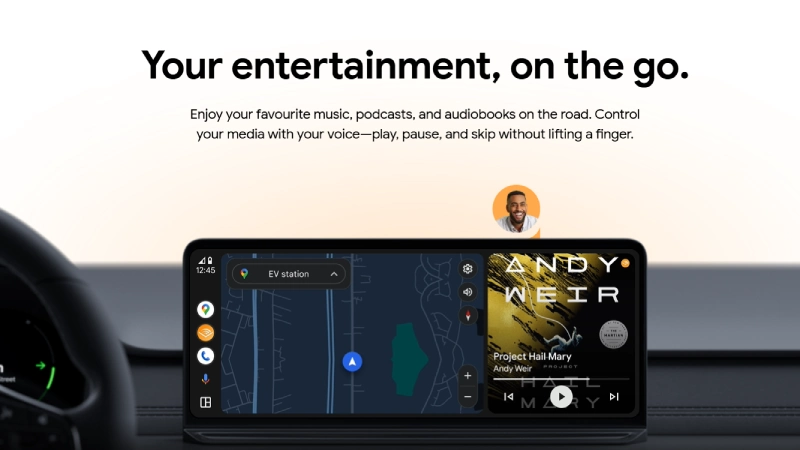
One of the recent discoveries in Android Auto, which was not just a surface-level visual change, is the company’s deep interest in the media sector. The mention of Google Cast’s capabilities and the new media templates suggests that the tech giant is exploring different ways to handle audio and even video content while the user is parked. Although there is no official confirmation, these indications are strong enough to suggest that Android Auto is on the way to becoming a more valuable and versatile entertainment platform rather than just a phone projection tool.
Changes of this nature would bring Android Auto closer to Android Automotive, Google’s complete in-car operating system for carmakers such as Volvo and Polestar. Even though the two platforms remain separate, the gap between them is shrinking, especially in multimedia and user interface capabilities.
AI and What Comes Next for Android Auto

More intelligent voice interactions would allow drivers to perform navigation, send messages, and control media using casual, more human-like language, thereby eliminating the need for interaction with the screen altogether. When combined with the subtle UI improvements like the new progress bar, these adjustments are indicative of a future where Android Auto is perceived as being more responsive, intuitive, and personalized.
The Evolution Is Slow But Intentional
The latest updates to Android Auto are not particularly noticeable and won’t attract as much attention as the redesign, but they still reveal Google’s long-term plan. The tech giant is not in a hurry with new features; instead, it is polishing the interface and increasing the platform’s age, and it is also preparing the platform for AI enhancements.
The outcome for users is a system that changes at a slow yet steady pace, where security is a priority, and that is simultaneously becoming more powerful in subtle ways.
