





Table of Contents
Highlights
- True holographic displays with real light-field depth are still largely experimental.
- Light-field and volumetric systems are practical today but limited in viewing angles and resolution.
- Major roadblocks include computing power, energy use, content shortages, and human comfort.
- Mainstream free-space holography is more plausible in the 2030s, not in the near term.
For decades, holographic displays have lived comfortably in the realm of science fiction. From shimmering blue projections in Star Wars to floating interfaces in cyberpunk cinema, holograms symbolized a future where screens dissolved into thin air. In 2025, that future feels closer but still incomplete. Holographic display technology has made real, measurable progress, yet it remains constrained by technical, economic, and human-factor challenges.
This feature article examines where holographic displays truly stand today: the prototypes that work, the limitations that persist, and the realistic timeline for mainstream adoption.
What do we actually mean by “holographic displays”?
The term “holographic display” is often used loosely. In popular discourse, it refers to any 3D visual that appears to float in space. Technically, however, true holography involves recording and reconstructing light fields so that images possess real depth, parallax, and perspective without requiring headsets or special glasses.
Most products marketed as “holographic” today fall into adjacent categories:
- Light-field displays that simulate depth using layered images
- Volumetric displays that project images into a physical space
- Mixed-reality headsets that overlay 3D visuals onto the real world
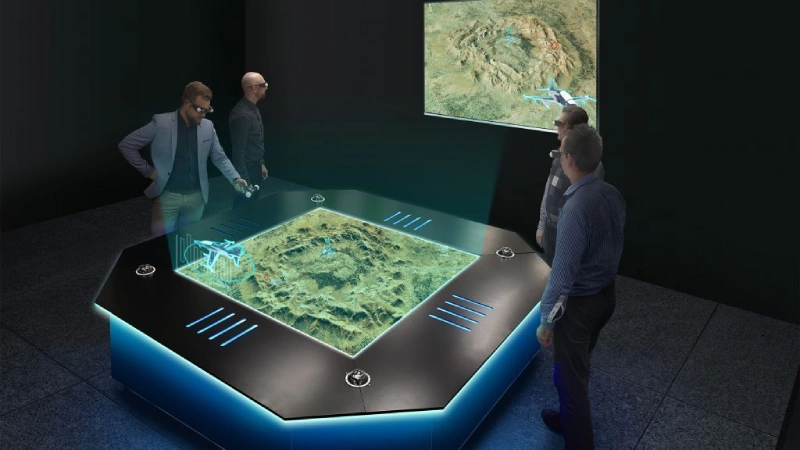
Genuine, free-space holograms, walk-around, touchless projections like those in films, remain largely experimental.
Where progress is genuinely happening
Despite the hype gap, progress since the late 2010s has been substantial
Light-field and tabletop holographic displays
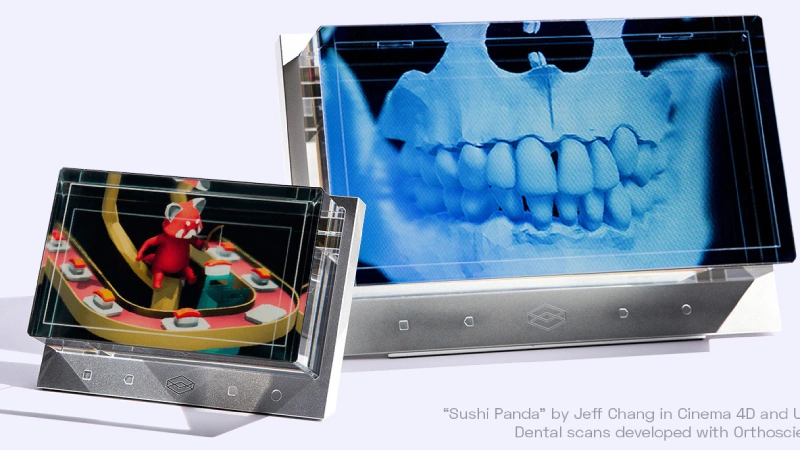
Companies like Looking Glass Factory have produced some of the most practical holographic displays available today. Their light-field panels allow users to view 3D content without glasses, offering real parallax and depth as viewers move around the screen.
These displays are already being used in:
- Medical imaging and anatomy visualisation
- Product design and industrial prototyping
- Scientific research and data visualisation
The key breakthrough here is usability. These systems work reliably, connect to standard computers, and support real-time 3D rendering, albeit within fixed viewing angles and controlled environments.
Headset-based “holography”
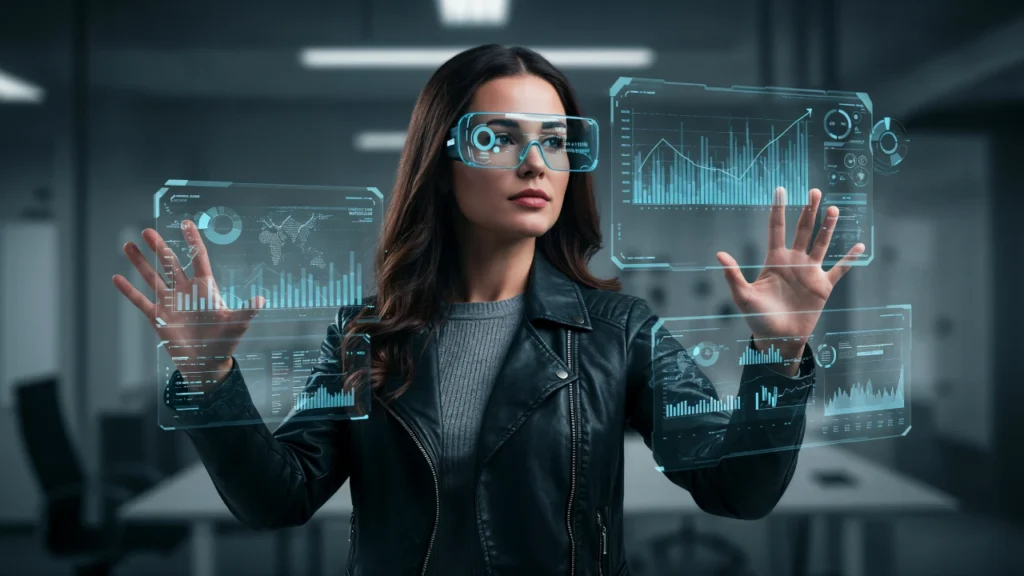
While not true holographic displays in the strict sense, mixed-reality devices have significantly advanced spatial computing. Microsoft HoloLens demonstrated that persistent 3D objects anchored in real space could be useful for training, manufacturing, and collaboration.
However, headsets remain a compromise. They offload the complexity of holography onto wearable optics and computing, sidestepping the more complex problem of projecting light directly into space. This makes them powerful but inherently limited in social and everyday contexts. Holography without wearables remains the ultimate goal.
Volumetric and projection-based experiments
Research labs continue experimenting with volumetric displays that use spinning surfaces, fog, plasma, or lasers to create images in mid-air. These demonstrations are impressive and often viral, but they are fragile, power-hungry, and unsuitable for continuous use.
They excel as proofs of concept, not consumer products. The leap from controlled lab environments to living rooms or offices remains enormous.
The core technical roadblocks
Despite visible progress, holographic displays face several fundamental challenges.
1. Computational intensity
Rendering an authentic hologram requires calculating and projecting light waves at extremely high resolution and refresh rates. The computational load is orders of magnitude higher than rendering a flat image or even stereoscopic 3D.

Even in 2025, real-time holography strains high-end GPUs. Scaling this to consumer-friendly hardware remains a significant obstacle.
2. Display resolution and viewing angles
Current holographic and light-field displays trade resolution for depth. As the number of viewing angles increases, image sharpness drops. This makes fine text, detailed interfaces, and long-distance viewing difficult.
For mainstream adoption, holographic displays must match or exceed the clarity of conventional screens. That threshold has not yet been crossed.
3. Power consumption and heat
True holography is energy-intensive. Prototypes often require significant power and generate heat that limits portability and longevity. Until efficiency improves dramatically, battery-powered holographic displays will remain impractical.
4. Content creation bottlenecks
Even if perfect displays existed, there is a shortage of native holographic content. Creating holographic experiences requires new tools, workflows, and design languages. Flat UI paradigms do not translate cleanly into volumetric space.
Without a compelling content ecosystem, hardware adoption stalls, and without hardware adoption, content creation lags.
Human factors: the overlooked challenge
Technology alone does not determine adoption. Humans do. Extended use of 3D displays can cause eye strain, fatigue, and cognitive overload. Depth cues that feel exciting in short demos can become exhausting in daily use.
Designers are still learning how much dimensionality is helpful and when it becomes noise. There is also a social dimension. Floating displays raise privacy questions in shared spaces. Not all information wants to be visible from multiple angles.
Mainstream adoption requires holography to feel natural, unobtrusive, and optional, not overwhelming.
Where holographic displays already make sense
While consumer ubiquity remains distant, holographic displays are already viable in specific domains:
- Healthcare: visualising scans and surgical planning
- Engineering and manufacturing: spatial inspection of complex parts
- Education and research: interactive 3D models
- Museums and exhibitions: immersive storytelling
In these contexts, cost, size, and setup complexity are acceptable trade-offs for spatial insight.
When might mainstream adoption begin?
The honest answer: not imminently, but not indefinitely either.
Between 2025 and 2030, we are likely to see:
- Improved desktop-scale holographic monitors
- Better integration with AI-driven 3D content generation
- Reduced costs for professional and prosumer use

Mass-market consumer holographic displays: affordable, compact, and content-rich, are more plausibly a 2030s phenomenon, assuming breakthroughs in computation, optics, and energy efficiency. Importantly, adoption may not replace screens outright. Instead, holography may complement them, reserved for tasks where spatial understanding truly adds value.
The role of AI in accelerating progress
One quiet accelerant is artificial intelligence. AI-driven rendering, compression, and content generation could dramatically reduce the computational cost of holography. Neural radiance fields (NeRFs) and generative 3D models already hint at a future where holographic content is easier to create and manipulate.
AI will not solve physics, but it may soften many of the practical barriers.
Conclusion
Holographic displays are no longer pure fantasy. They exist, they work, and they already deliver value in specialized settings. Yet they are not the seamless, ubiquitous projections imagined by science fiction.
Still, the roadblocks – computational load, resolution, power, content, and human comfort – are honest and stubborn. Progress is steady, but evolutionary rather than revolutionary.
The most likely future is not one where screens disappear overnight, but one where holography quietly earns its place alongside them. When it finally becomes mainstream, it will not feel like science fiction: it will feel obvious, useful, and human. And that, paradoxically, may be the clearest sign that the holographic age has truly arrived.
