





Table of Contents
Highlights
- Digital twins create real-time virtual replicas that mirror physical systems for testing and optimization.
- The technology is already transforming building management, urban planning, and healthcare decision-making.
- Digital twins reduce uncertainty by enabling simulations and “what-if” analyses before real-world changes.
- Data quality, privacy risks, and interoperability remain key challenges to widespread adoption.
“Digital twins” have progressed from technical briefings into common discussion at planning sessions, strategic sessions at hospitals, and other corporate presentations. Defined, a digital twin refers to a living model of an entity, often an industrial entity like an aircraft engine, created as an accurate digital duplicate, living alongside its tangible counterpart, receiving the same data inputs, reacting in the same way, and mirroring the behaviour of the original entity in real time. It is associated with real-time data feeds, reflecting behaviour, modelling, and “what-if” analysis tests in an Eco-friendly virtual world before modifications in the actual entity are executed.
Applications of digital twins today
Buildings and infrastructure
In the built environment, digital twins have one of the most advanced applications of the technology. Here, architects and engineers integrate design models with heating and cooling system sensor data, occupancy data, and energy consumption data from the meter to create a comprehensive, harmonious system representation of the structure from start to finish.
The analysis and comprehensive system representation enable smooth commissioning and predictive maintenance of the structure by correcting equipment problems before they occur. Eventually, the effects of the systems and structures result in lower operating costs and favourable climatic conditions within the environment. Other significant projects involving the construction of structures, such as bridge systems or the public transport network, would use the digital twin to assess the impact of changes to the system design.
Urbanization and urban planning
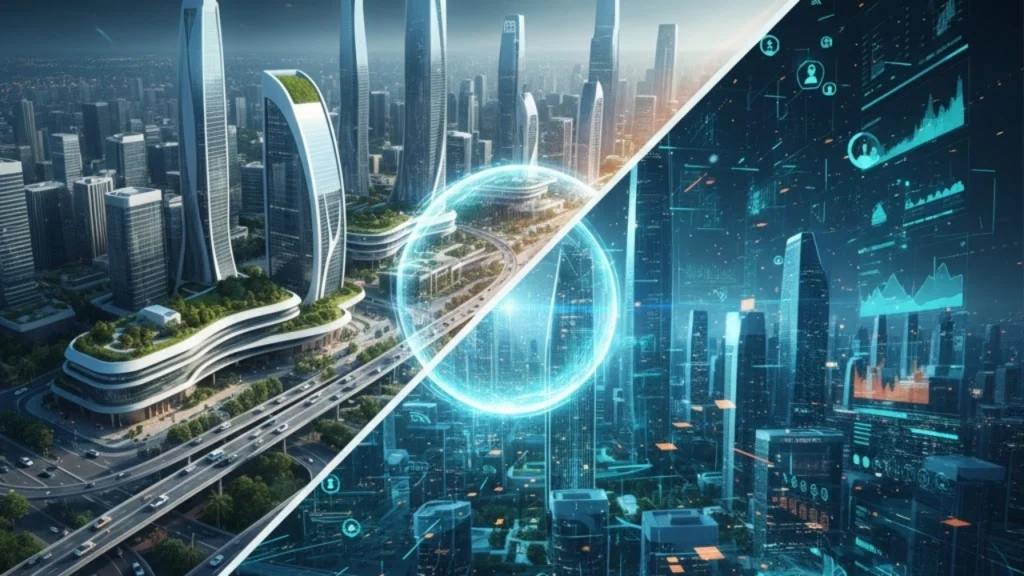
When the method is scaled up for use within a neighbourhood or an entire city, it becomes an effective planning method. City-scale twins integrate three-dimensional geometry, records of land use, mobility dynamics, weather conditions, and utility infrastructure, serving diverse operations from training for emergency disasters to infrastructure investment over extended periods. Scenarios for modifications in traffic flow, the addition of new park sites, or flood control measures can be analyzed for their effectiveness using the replica city, which operates virtually, enabling uninterrupted operations. It functions more like a lab for testing policies to evaluate the factors of resilience, investment, and community impact before final investment.
Healthcare & Personal Digital Twins
The idea of a twin as a patient or as a personal twin shifts the technology into the medical and wellness space. Such twins are built using healthcare data, wearable device data, medical imaging, genomic data, and population-level data. By doing this, the twin of a particular person’s health and wellness programs the doctors to virtually test possible treatment plans, predict the likely outcome of a disease, or optimize device settings before it enters the medical space. Preliminary studies have shown the potential for lower adverse event rates and more personalized treatment plans. However, this technology requires robust validation before it impacts the mainstream.
The advantages and disadvantages of digital twin technology
Across different industry domains, the reasons for adopting digital twins are no different: better decision-making and minimizing uncertainty. Simulations and analyses of digital twins enable better risk forecasting and consequence analysis. Digital twins would allow organizations to analyze various options before commencing physical work, thereby avoiding potential surprises that could lead to losses once physical operations begin.

Risk management and training are another major group of benefits. These include activities that may be practiced by first responders, facility personnel, or infrastructure managers in a lifelike setting but are consequence-free. When a series of benefits interact, such as using a twin replica for mitigating traffic congestion that in turn results in lower emissions and improved access during emergencies, for example, overall social and economic value can be high. The twin function is essentially that of a decision engine whose influence multiplies for the better by enabling better decisions.
Main tasks and limitations
Despite all the advantages, specific obstinate issues slow the adoption process and pose fresh risks. The first among them is data, and the replica is only as good as the data it is fed. Sensors fail, and data from different manufacturers is neither standardized nor of consistent quality, while gaps in historical data undermine the credibility of the models. A strong pipeline is necessary for critical tasks such as bridge integrity predictions and clinical decision-making, and missing or noisy data does not work well with them.
Who owns and maintains the dataset for the twin can become a governance issue, one that turns out to be tougher than expected. Interoperability is another challenge in this area. With so many software tools, formats, and domain-specific languages, it becomes hard to piece together an integrated model for the whole asset life cycle. The lack of standard interfaces and semantic models can make the transition from design to operations problematic, leading to costly translations and even the loss of information.

Some efforts are underway to establish a standard. The problems of privacy and security multiply as replicas become more realistic and increasingly interconnected. By creating replicas of human beings and/or essential infrastructure systems, one makes a concentration of confidential information that becomes very tempting to hackers. The constant stream of sensors, edge computing, and cloud computing infrastructure increases the attack surface.
The legal parameters of minimizing digital information, revoking consent, and derivative ownership are, as yet, unclear. As far as ethical considerations, replicas of human beings raise significant concerns about informed consent, as well as the potential misuse of predictive models in insurance, employment, and surveillance.
Model fidelity and the temptation of overreliance on the illusion of certainty are other potential problems. A model mimicking well on a dashboard screen could be hiding assumptions and uncertainties. Small changes in boundary conditions can amplify errors in complex simulations. Unverified models can lead to suboptimal decisions. Model verification, validation, sensitivity analysis, and calibration are essential. These are especially true in safety-critical areas.
Finally, expense factors and organizational change must not be overlooked. Creating and maintaining a helpful replica will require investment in sensors, networking, processing, machine learning, and new job roles, such as data engineers. These may not be justifiable within smaller companies until cheaper-as-a-service alternatives emerge.
