


Highlights
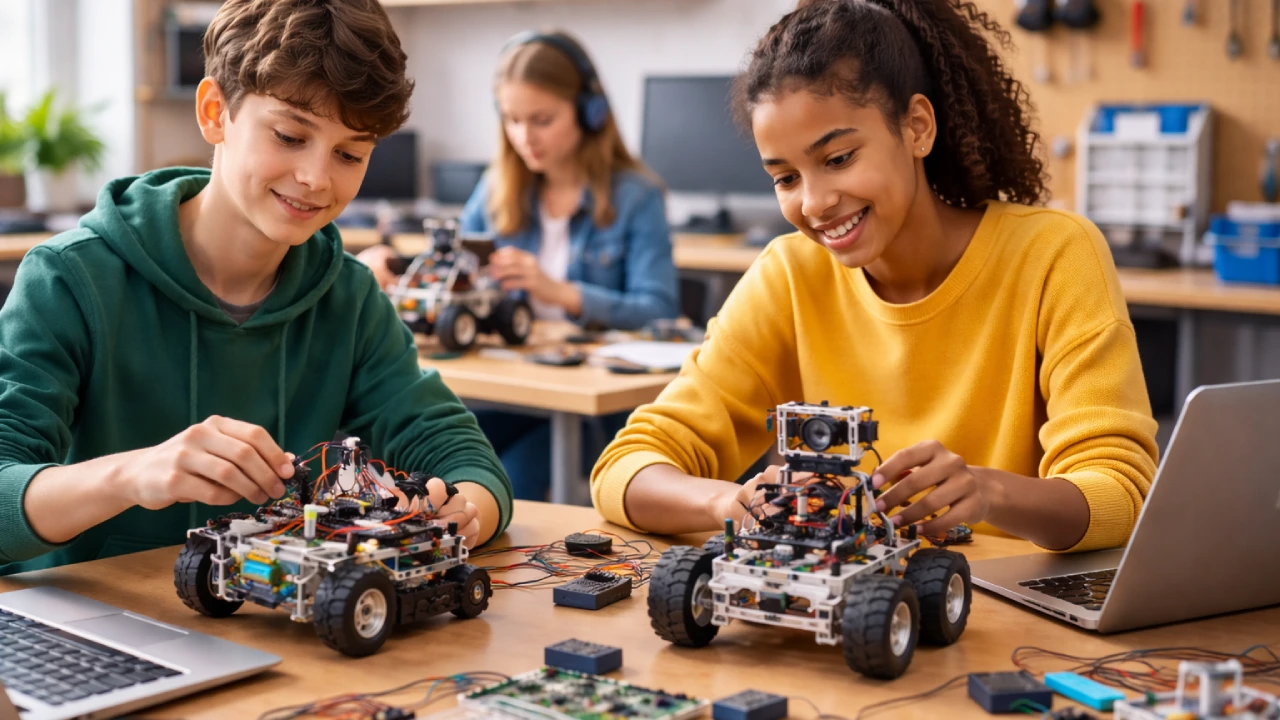
- DIY Robotics kits teach coding, electronics, and teamwork through hands-on experimentation.
- Kits range from block-based beginner sets to Arduino, Raspberry Pi, and competition platforms.
- Effective use requires scaffolding, teacher training, and balanced cost strategies for schools.
Robotics kits for learners occupy a unique place at the confluence of engineering, computer science, and craft. They are instruments of pedagogy as much as play: tactile, iterative, and immediately consequential. For students, they offer a concrete environment in which abstract concepts, loops, sensors, feedback, voltage, mechanical advantage, and modular design acquire visceral meaning.

This article evaluates the contemporary landscape of beginner robotics kits, assesses learning curves and cost structures, examines practical classroom and extracurricular uses, and considers the educational value these kits deliver for different age groups and learning goals.
Why robotics kits matter in education
Robotics condenses a wide range of skills from different disciplines into one, and at the same time, they are the kinds of projects that allow for and reward the testing and exploration of new ideas. A robot project alone can impart knowledge about electricity and wiring that are not so complex, about mechanics and sensors, Heuristic thinking and debugging, and finally, but not least, teamwork.
Robots behave in a way that is easy to see, hence the feedback loop is short: the motion caused by the code leads to a test, which results in revising the code. This rapid exchanging of hypotheses and corrections is the very pedagogical dynamic that educators want when teaching scientific methods and making use of computational thinking.
Moreover, the motivational value is equally important. The concrete reward of a robot that moves is, for a lot of students, the main factor that keeps them interested for a longer time than abstract exercises would. Robotics projects are adaptable to different levels of complexity, thus making it possible to scaffold successively: start with block-based programming and prebuilt modules, then move to textual coding, custom circuitry, and mechanical modification.
Categories of kits and their educational aims
The most guided kits emphasise plug-and-play modularity and block-style programming. These are intended for young learners and beginners who require immediate wins. They minimise soldering or complex wiring and often include colourful chassis, snap-in sensors, and visual programming environments.
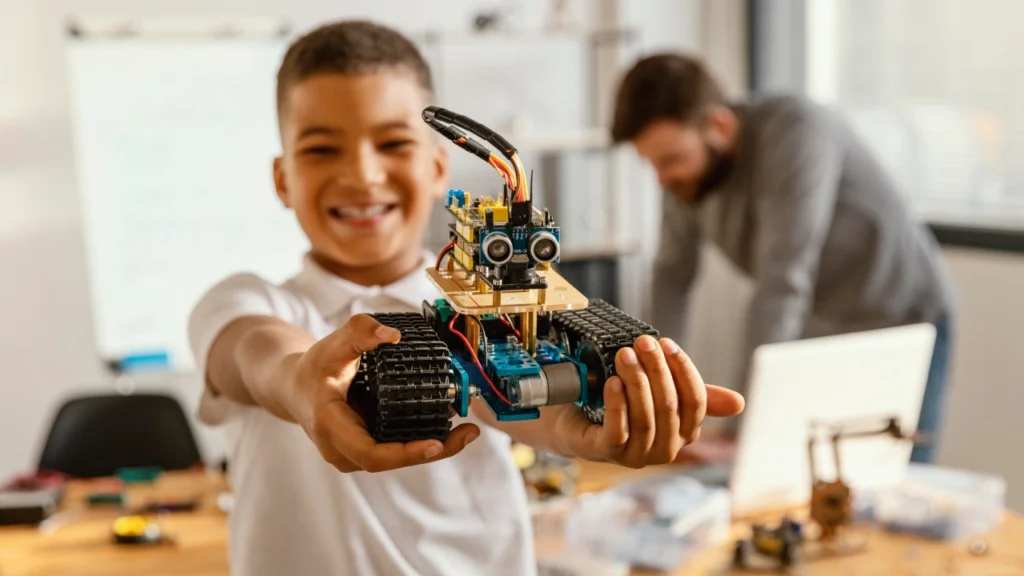
Mid-range kits are characterised by their hybrid nature, which consists of modular hardware and the brief engagement with textual programming. Usually, these kinds of kits contain microcontrollers (or microcontroller-like boards), cooperation in both visual and Python/C++ coding, and a range of sensors and actuators. Hence, these kits are extremely useful for students from middle school to early high school who are ready to cross over from the conceptual world into the coding one.
Open kits, with amateur or hobbyist orientation, lay emphasis on flexibility and scaling. Standard hardware platforms often underpin such kits— the Arduino ecosystem, Raspberry Pi single-board computers, or general-purpose motor controllers— and they expect users to have or to gradually acquire basic electronics and programming skills. They are suitable for older students, makerspaces, and clubs getting ready for competition.
Moreover, competition-based systems are among the features that afford the greatest performance, the ability to upgrade modularly, and the creation of the design according to the rules. They are effective in teaching systems engineering as well as project management and optimisation under constraints; however, the learning curve is much steeper, and the cost is higher for these systems.
Representative products and product evaluation
Several kits exemplify the different trade-offs schools and hobbyists face. I discuss them here not as an exhaustive market survey but as archetypes that illuminate pedagogical choices.
A family of education-first kits prioritising simplicity and instant success. Their main features are easy block-based programming, a variety of sensors that can easily be plugged in (light, ultrasonic, line follower), and a sturdy body. Their strong point is very low resistance: kids can build a robot and show it doing things in one hour. The educational advantage is quick motivation and early acquaintance with control flow, sensor feedback, and debugging. Their drawback is the ultimate ceiling effect: after mastering basic behaviours, kids will soon be bored with the kit unless it has extensions or ways into text coding.
Among the different types of kits, the Arduino-based starter kits are the ones that represent the middle ground. They kick off the entire process by opening up the world of breadboarding, discrete components (LEDs, resistors, transistors), and microcontroller programming in C/C++ or its trimmed-down version, to the students.

Compare Fibre/Unsplash
Compared to more refined consumer goods, these kits are inexpensive, and at the same time, they pass on the essential electrical reasoning: voltage, current, pull-up resistors, and reading analogue sensors. The students might find the process a little difficult as they have to manage wiring and be versed in error messages, but the end result is pristine technical literacy and transferability: What you learn with Arduino is easily transferable to other embedded systems.
Raspberry Pi-centric kits shift the focus from microcontroller control to full single-board computing. They introduce networking, Linux, multimedia, and higher-level languages (Python) alongside robotics. These kits are excellent for projects that require image processing, natural language interfaces, or sophisticated autonomy because the Pi’s computing power supports computer vision and machine learning experiments. The trade-off is complexity and cost: Pi projects require more setup and a steeper learning curve to manage OS, file systems, and peripheral configuration.
Competition platforms such as VEX or investment-grade modular robotics teach systems engineering under constraint. They come with high-quality motors, gearboxes, and defined scoring tasks. For students aiming at robotics competition pathways (VEX, FIRST), these systems are instructive but require sustained mentoring, team coordination, and budgetary commitment.
Learning curve and scaffolding strategies
The success of a robotics kit from the pedagogical point of view mostly depends on the quality of the instructional scaffolding provided rather than the kit itself. A typical sequence that many teachers follow starts with the guided discovery (build a simple rover, make it run), then goes on to structured challenges (following a line, avoiding obstacles), and finally ends up with the open projects (create a robot for delivery, control a greenhouse sensor array).
For younger students, block-based programming environments (Scratch variants, block wrappers over microcontroller APIs) lower cognitive barriers and make control structures visible. Teachers should prioritise short, iterative projects with immediate, observable outcomes and constrained vocabularies of sensors and actuators to avoid overwhelm.
For older students, introducing textual programming alongside physical debugging is ideal. The crucial pedagogical step is connecting abstract constructs (for loops, conditionals) to physical phenomena (motor PWM, sensor noise). Debugging physical systems teaches tolerance for imperfection and the need to instrument systems—for example, logging sensor values to reason about behaviour rather than relying purely on intuition.
Assessment should reward experimentation and documentation. Project rubrics that allocate points for reproducible demonstration, code clarity, and design rationale encourage disciplined practice rather than merely successful outcomes.
Cost and resource considerations
The prices of these kits vary a lot. The most elementary kits designed for class usage can be quite inexpensive, thereby making them affordable for small schools and after-school programs. Arduino and micro: bit are low-cost and have a strong support base of free teaching materials. Raspberry Pi and contest platforms’ unit costs are high, and at times they might require a recurring expense (like sensors, motors, batteries, and parts for repairs).
There are also some additional costs that the institutions should take into consideration apart from the unit price, such as spare parts, chargers for the rechargeable batteries, safe storage, and instructor training.
One pragmatic approach is blended procurement: buy a few advanced kits (Pi or competition platforms) for in-depth club work and larger numbers of simpler kits for introductory classes. This approach scales experience while enabling aspirational pathways for motivated students.
Conclusion: measurable returns when deployed thoughtfully

When used in a variety of coherent pedagogical designs, DIY robotics kits become powerful educational tools. The strengths of these kits are apparent: students’ high engagement, fast feedback loops, ability to learn across different subjects, and very good support for computational thinking, to name a few. The best implementation comes when the whole range of kits is used to facilitate learners’ progression, teacher training is regarded as a vital investment, and projects are set up that demand documentation, iteration, and teamwork as key components.