

Highlights
- OpenAI Codex app enables multi-agent parallel coding with Git worktrees.
- Skills and automations extend AI use beyond coding into design and deployment.
- Temporary free access expands availability across ChatGPT tiers.
- Tool sparks debate over developer productivity and job relevance.
OpenAI has unveiled the Codex app for macOS, a groundbreaking tool that’s set to transform software development by enabling developers to orchestrate multiple AI agents seamlessly.
Launched on February 2, 2026, this standalone application positions OpenAI as a fierce contender in the booming AI coding assistant market, directly challenging rivals like Anthropic’s Claude Code and Cursor.
With over a million developers using Codex in the past month, the app introduces “vibe coding” for parallel task management, skill extensions, and long-running AI collaborations. CEO Sam Altman calls it OpenAI’s most beloved internal product -yet admits feeling “a little useless” when AI ideas surpassed his own.
What is the Codex App?
A Command Center for AI Coding Agents
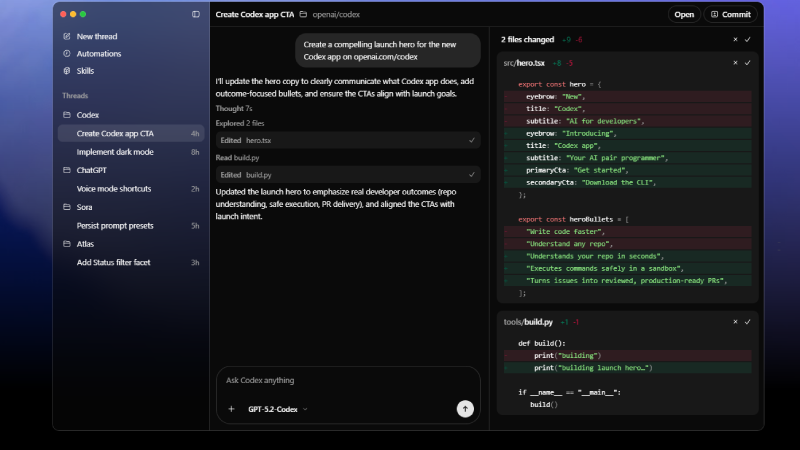
The Codex app acts as a centralized hub for directing multiple AI agents at once. Unlike traditional IDEs struggling with orchestration, it uses project-specific threads for seamless task-switching, real-time diff reviews, comments, and external editor integration.
- Key Benefit: Built-in Git worktrees create isolated environments, avoiding conflicts on shared repos – a true game-changer for complex projects.
Seamless Integration with Existing Developer Workflows
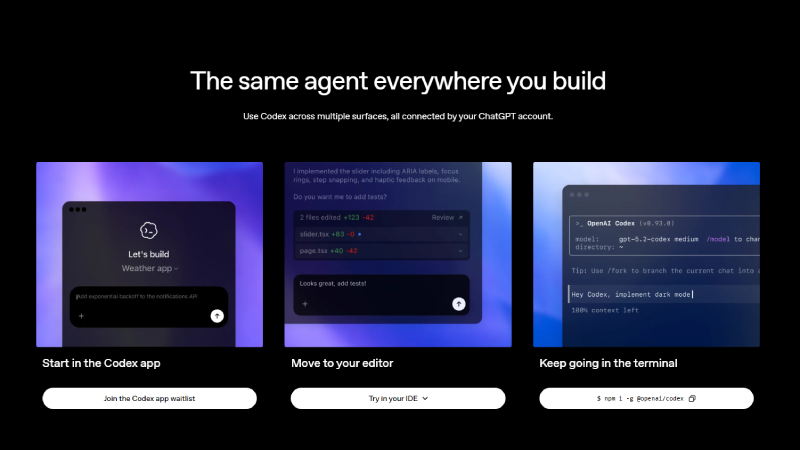
It imports session history from Codex CLI/IDE extensions for zero disruption. Developers check out changes locally or let agents run independently, boosting productivity across desktop, cloud, CLI, and IDEs.
This flexibility makes Codex more than a coding assistant – it functions as an AI project manager for software teams.
Key Features that Set OpenAI Codex App Apart
Multi-Agent Parallel Workflows
Codex manages long-running tasks (hours to weeks) via parallel threads, maintaining full context – from design to deployment.
- Demo Spotlight: Built “Voxel Velocity” (3D Three.js kart racer) autonomously with 7M+ tokens – one prompt turned AI into designer/developer/QA, adding drifts, AI behaviors, and 8 playable tracks.
Skills: Extending Beyond Code Generation
“Skills” bundle instructions/scripts for advanced tasks, with an app interface for creation/management.
- Figma: Design-to-code with 1:1 parity.
- Deployments: Vercel, Netlify, Cloudflare, Render.
- Media/Tools: GPT Image visuals; Linear triage; PDF/spreadsheet/DOCX editing.
- Use Case: Auto website updates or bug backlogs.
Automations and Custom AI Personalities
- Automations: Scheduled background tasks (e.g., CI summaries, release briefs) queue for review.
- Personalities: Switch between terse/execution-focused or conversational via /personality command.
Security: Strengths and Concerns
- Positives:
- Open-source sandboxing limits to project folders.
- Permission gates for network/elevated access.
- Negatives:
- Misconfigured rules risk unintended code execution.
- Team vulnerabilities if not audited.

Availability and Pricing of the Codex App
The phased rollout strategy also suggests OpenAI is prioritizing feedback from early adopters before expanding platform support. Windows compatibility is expected to significantly broaden Codex’s reach, especially among enterprise developers and large teams that rely on mixed operating system environments.
- Platforms: macOS immediate (Windows roadmap).
- Access: Bundled in ChatGPT Plus/Pro/Business/Enterprise/Edu; credit top-ups available.
- Promo: Free for Free/Go tiers; doubled paid limits—hooks users but ends soon, potentially frustrating.
Positive and Negative Impacts on Software Development
The Positives: Empowering Developers
- Democratization: Vibe coding lets non-experts build enterprise apps on their own.
- Speed Surge: Usage doubled post-GPT-5.2-Codex; Altman’s late-night excitement proves internal value.
- Enterprise Edge: Full-lifecycle skills/automations surpass single-agent rivals.
The Negatives: Shadows of Disruption
- Job Fears: Altman’s “sad/useless” tweet (India Today) highlights deskilling as AI ideas excel.
- Over-Reliance: Hallucinations/bugs risk production fails; models lack human intuition (The Hindu).
- Market Lag: Behind Anthropic’s $1B Claude Code; OpenAI catching up amid pressures.
- Gaps: Mac-only excludes Windows/Linux; promo may lead to costly lock-in.
Codex vs Claude Code vs Cursor: Competitive Landscape and Future of AI Coding Tools
OpenAI fights back with multi-agent strengths amid heated rivalry. Roadmap includes faster inference and cloud automations.
Codex bridges AI power to practice, accelerating innovation positively, while negatively questioning human roles in coding.
Codex isn’t replacing coders, actually, it is amplifying them. With 1M+ users hooked, it redefines “who builds software.”
Ready to dive in?