
Highlights
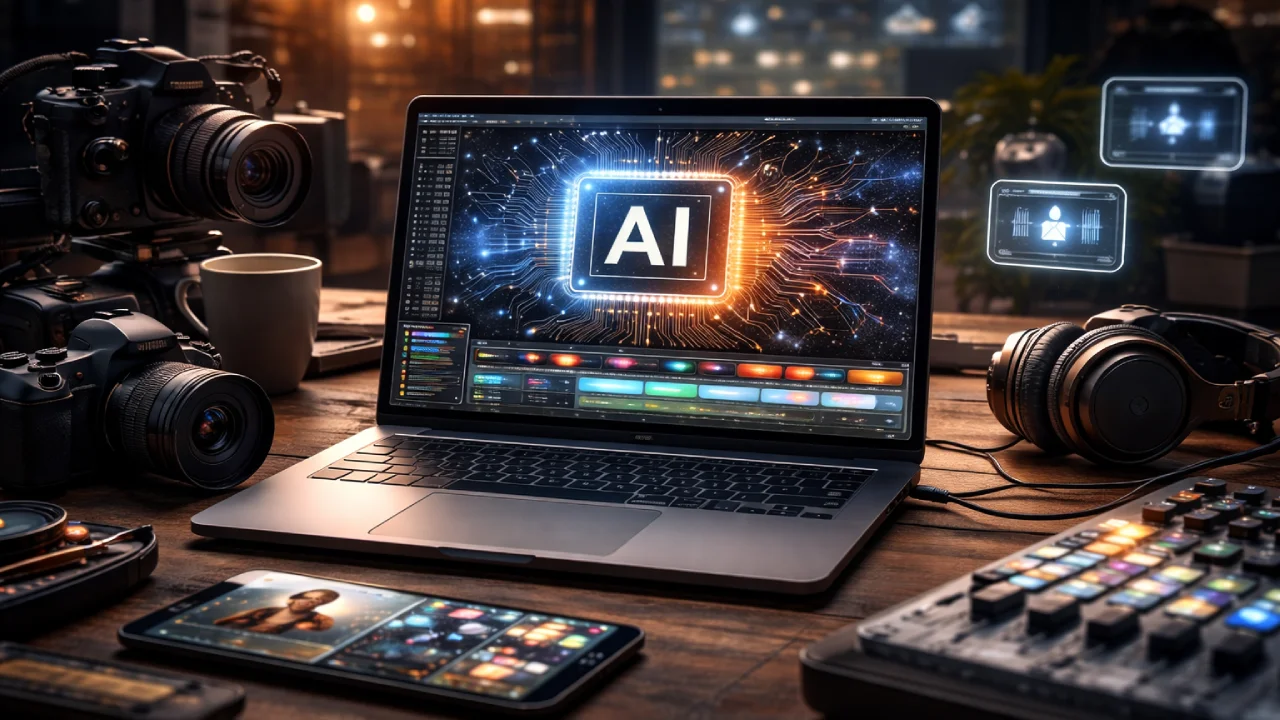
- AI video editor automates cutting, captions, colour correction, and content pacing.
- Speed and consistency now outweigh technical perfection in the creator economy.
- Professional editing tools remain essential for complex storytelling and creative control.
- AI is reshaping editing workflows by acting as an assistant, not a replacement.
Video editing was a professional skill and an art that was mastered through trial and error over years of using and learning the very powerful software. The timeline was a nightmare for the unskilled, and colour grading needed a specialist’s know-how. Also, the final video could take many hours to export. The barrier was such a wall that it could not be crossed by anyone except trained creators who had professional editing in front of them. In 2025, that wall is being torn down.
The AI-editors have come forward with the promise of giving results in minutes instead of hours. The creator just has to upload the footage and pick a style, and the algorithms will automatically handle cutting and editing, along with transitions, music, captions, and even pacing. For these new creators emerging, editing has become a process of supervision rather than one of mastering the skill.
This change demands a question to be asked: are video editors like the ones using AI replacing the professional tools or merely redefining who the “professionals” are?

How AI Editors Work Behind the Scenes
The latest generation of AI video editors are integrating a number of machine learning models that have been trained on large amounts of footage, cutting patterns, and viewer engagement metrics. They already have the capability of recognizing faces, detecting scene changes, analyzing audio quality, and even figuring out the emotional tone of the video.
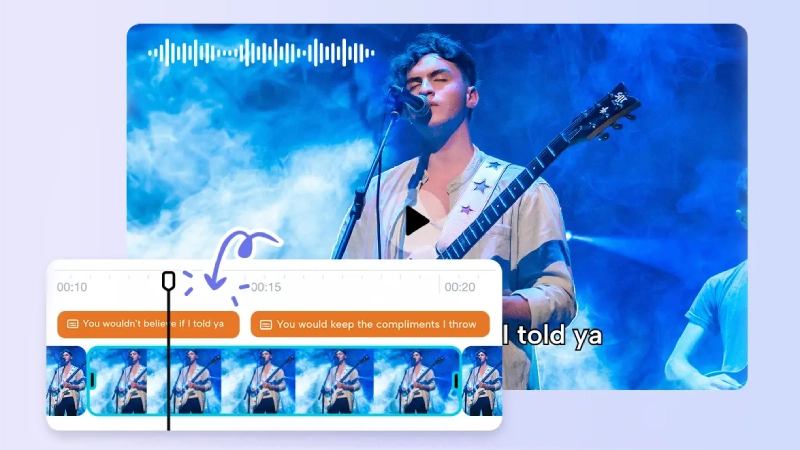
The moment the footage is uploaded, the software steps in to do the work of automatically cutting out silences, getting rid of filler words, leveling the audio, and picking the most visually attractive clips. Some programs pass the editing stage by doing color correction, adding captions, or even recommending B-roll content and background music according to the content type.
What it is that really attracts a filmmaker to these editors is not just automation, but also the fact that an editor’s decision is made. AI merely doesn’t follow the commands set by the user; it makes editorial decisions that are sometimes even based on the social platform’s patterns that work well.

The Rise of Speed as a Creative Value
AI editors have brought a significant change, the quality of content is being defined anew. Quality in the past was closely tied to a technical and aesthetic level where imperfections were totally not allowed. However, the modern creator economy has a different meter now where quality is directly measured by the associated relevance, frequency, and engagement.
AI editors are the winners in this context. They facilitate the creation of more content to be distributed quickly with formatting that is always consistent and optimised for the various platforms. For marketers, influencers, educators and small businesses, speed is often the most important factor even more than the aesthetic of a movie.
In contrast to these professional tools, these premium solutions require a substantial amount of time to be spent on them. They provide the best control but the price is the same: attention, skills, and often powerful hardware are needed.
The outcome is a definite separation: AI editors put quality of content below the ability to deliver it, while traditional software puts the opposite scenario in their equation.

What AI Editors Do Well: And Where They Fall Short
AI-powered editors really do shine in well-structured and repeatable workflows. Talking-head videos, podcasts, tutorials, and social media clips are particularly well-suited to automation. Tasks such as jump cuts, subtitle generation, aspect ratio adaptation, and platform-specific formatting are handled with remarkable efficiency.
However, creative ambiguity remains a challenging area for AI. It is difficult for AI to understand unconventional storytelling, experimental pacing, and nuanced emotional beats. AI can put together the footage as it likes, but it cannot yet understand the intent of the human editor as a human would.
Complex projects involving layered effects, detailed colour grading, sound design, or narrative rhythm still demand professional tools and human judgment.
The Viewpoint Of The Professional Editor:
The wave of AI tools has caused mixed feelings among professional editors; on one hand, they feel uneasy, and on the other hand, a little bit liberated. The reason for the first point is that the automation may eventually make the basic editing processes which used to be the basis for professional fees and thus, the professional fees get truncated or even cut off. The second point is that the tedious work of editing is eliminated and therefore the editors can give their attention on making the right creative decisions at a higher level.
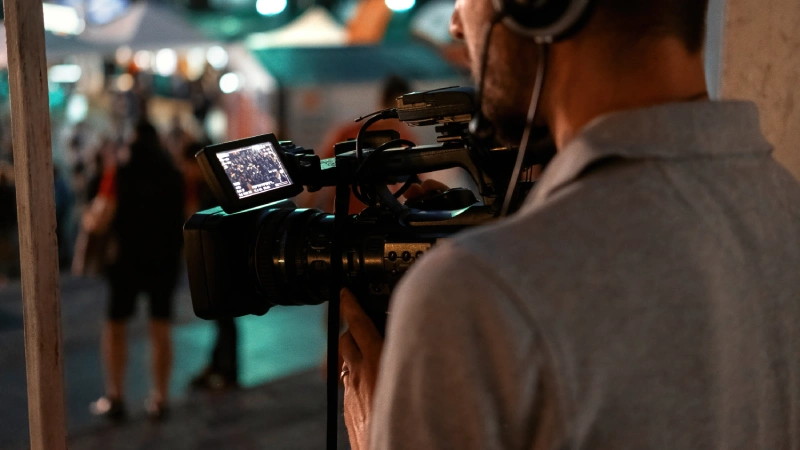
AI is being used in a lot of studios as an assistant instead of a replacement already. Cutting rough drafts is automatic, transcripts are generated instantly, and metadata tagging is handled by algorithms. After that, human editors smooth, reshape, and make the material even better.
This teamwork puts forth the need for a future where professional tools will be designed to incorporate AI instead of just being in competition with it.
Cost and Accessibility: A Major Shift in Power
Professional software in the past was always costly, and had additional costs like subscription fees, hardware requirements, as well as long time learning curves. AI editors, however, are usually cloud-based, cheap, and easy to use.
This has opened the door for everybody who is interested in video creation. One-man bands and small groups can make the same content that just a couple of years ago would have needed professional resources. At the same time, the amount of online video content has increased tremendously.
But as it is said, “the more the merrier”, meaning that there is a larger audience, but at the same time, it is hard to get noticed. If everybody can edit, then it takes more than just technical skill to stand out; originality and character are the next requirements.
Creativity vs Algorithmic Optimisation
AI editors are one of the most subtle yet important concerns when it comes to creative influence. Due to the high-performing content training of several AI tools, the tendency is to reinforce existing trends.
AI-edited videos tend to look and feel alike — familiar pacing, predictable transitions, optimised hooks. This uniformity not only helps the engagement metrics but also poses a risk of reducing creative diversity.
Professional tools, though more challenging to use, free the users from the algorithmic taste. They give the editors a chance to experiment, to set new standards, and to create their own visual identities.
The struggle between optimisation and the expression is expected to be the characteristic of the next video-making phase.
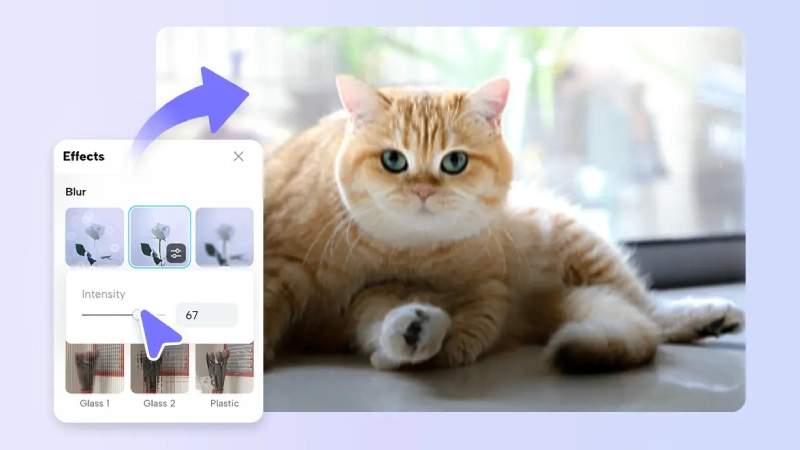
Image Credit:Pipit AI
Platform Influence and the Creator Economy
The social platforms are the main drivers of AI editor adoption. Algorithms give preference to consistency, frequency, and platform-specific formatting; these are all the areas where AI outperforms. The creators’ focus is on the quickness and the output rather than on the quality of the work. In such a scenario, the AI editors are no longer mere tools but have become strategic advantages.
Professional tools continue to dominate in the areas of film, television, and high-end advertising, but the online content market has shifted its centre of gravity. The question is no longer about whether AI tools are “good enough,” but rather whether they are good enough quicker.
Will AI Replace Professional Video Editors?
The answer, at least in 2025, is no, but it will change the use of professional editing.AI editors are not taking away talent but rather providing help in the performance of tasks. They are very good at doing the mechanical work, but they definitely do not have the intuition, emotional intelligence, and creative judgment that are the hallmarks of great storytelling.
Professional tools will still be essential for complicated, high-stakes projects. However, the professionals who disregard AI will be those who fall behind in the competition with the AI-assisted ones. The editor of the future will not be the one who competes with AI but rather the one who knows in which AI’s work will be the most fruitful and when it is time to take control once again.
Conclusion: A Redefinition, Not a Replacement
AI-enabled video editors will not cease the existence of professional video editing. They are the ones changing it.In their attempts to make the overall process less complicated technically, they are leading a lot more people to participate in the creative process. They are also changing professionals’ ways of spending their time with routine tasks being done automatically. Furthermore, they are the ones encouraging certain types of video content to be seen more across the internet, for engagement, in exactly the same way as a trendsetter does.

In 2025, the main difference will not be between the use of AI and non-AI tools but with the capacity of creation by the ones who adapt and the resistance of the ones who still keep the old ways. The industry of video editing will not be the sole arena of the machines or humans : it will be the one where all who master the art of using the two concurrently will be victorious.