

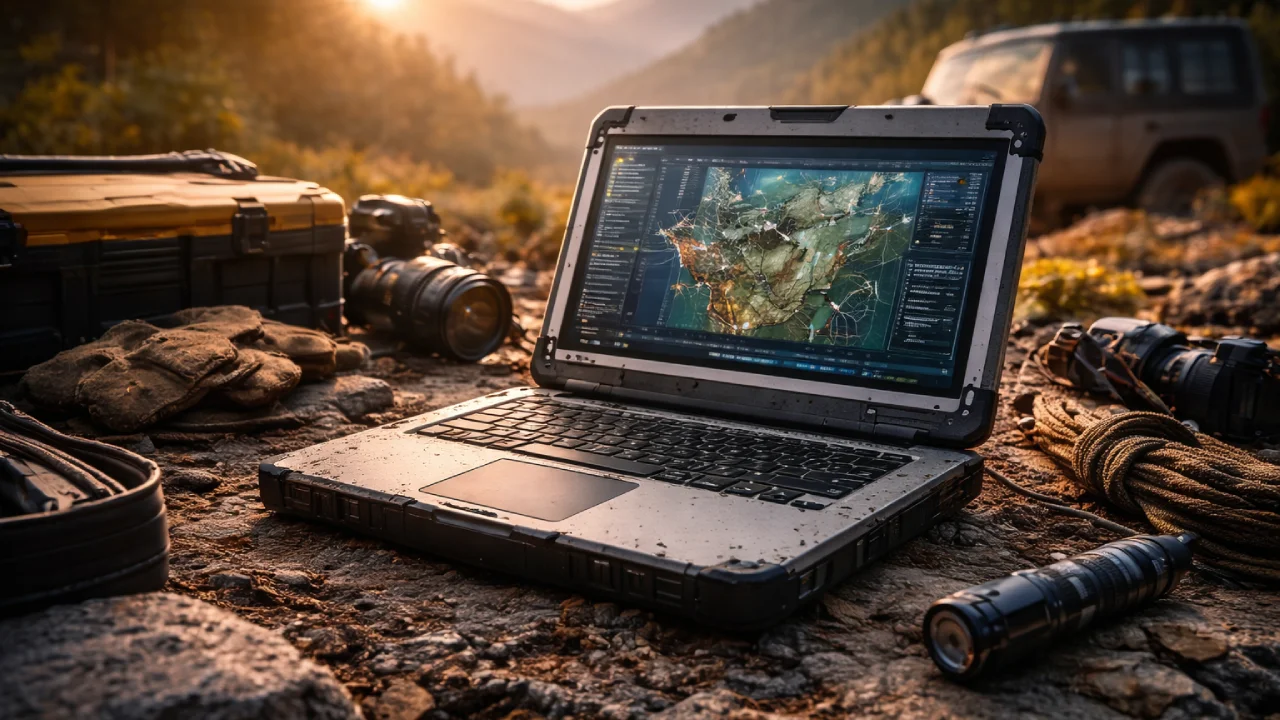
Highlights
- Compact rugged laptops now combine military-grade durability with modern portability.
- Battery life and reliability matter more than raw performance in field conditions.
- Bright outdoor-readable displays and extensive ports support real-world work.
- Rugged laptops offer long-term value despite higher upfront costs.
Rugged laptops are no longer the major protagonists of the markets, but nevertheless are still presenting the manufacturers’ performance over modern features, sleek as well as minimalist designs in a very conspicuous style. For field engineers, emergency responders, researchers, and frequent travellers, a cracked screen or water-damaged keyboard is not an inconvenience; it is a loss of the whole work process.
Compact rugged laptops have built up their reputation as well over the years. But, starting in 2025, the old stereotype has fallen with the new, more rugged and reliable, and at the same time, powerful and battery-friendly, machine generation. These gadgets are not meant to be the crowd pullers in boardrooms, but rather to withstand tough testing in construction, remote locations, and uncertain environments and still get the job done.
What is a Rugged Laptop Currently
Rugged laptops are designed to operate in conditions that would disable conventional machines. Apart from laptop usage, resistance to dust, moisture, vibration, temperature extremes, and physical impact are other factors that ensure the longevity of the products. Most rugged models meet military-grade durability standards, which give manufacturers the right to claim their products can withstand drops, shocks, and bad weather.

Scale has shifted. Compact rugged laptops aim to deliver this resilience in a form factor light enough for daily carry. Magnesium alloy frames, reinforced ports, sealed keyboards, and shock-mounted storage are now combined with modern processors and displays.
The result is a device that exudes function over form but no longer falls into the category of outdated technology.
Real World Performance
Benchmark scores like consumer laptops do not evaluate rugged machines. Their real test is reliability. They must be able to withstand extreme heat, dust, and vibration and still perform without failure.
Most compact rugged laptops of 2025 opt for efficient processors rather than high-performance chips. This decision cuts down the heat and extends the battery life, making it possible to have stable operation in long field sessions. Solid-state storage is the norm, and it minimizes the risks of failure due to moving or hitting. Graphics performance is usually low but adequate for activities like diagnostics, data collection, mapping, and paperwork. For outdoor work, predictability is more important than power.
Battery Life: Made for Long Days Away from Power
Battery life is one of the primary considerations regarding rugged laptops. Field engineers and travelers in remote or moving areas cannot always count on the availability of power outlets. Battery life, hot-swappable batteries, and aggressive power management are some of the tactics manufacturers have taken to entice buyers. Some rugged laptops are capable of working for an entire day if not more without needing to be plugged in for recharging.

Such an approach to battery life tells the truth of fieldwork, where reliability is determined in hours of no charging, not in minutes saved during charging.
Displays That Can Handle Harsh Conditions
A significant factor affecting the outdoor use of portable devices is visibility. Early rugged laptops solved this problem by high-brightness displays that could still be read in bright sun light. Moreover, Anti-glare coatings and reinforced glass added to usability in tough lighting environments. By the way, touchscreen technology has been getting very popular in the industry as it is feature allowing to work with gloves on and fast input in field. Despite that the displays do not compete with consumer laptop for colour accuracy or resolution, they do win in the most important factor: clarity during the difficult times.
Rugged laptops and their broad-spectrum ports were also made for the field work, which cannot be done without connectivity. Rugged laptops sometimes offer even more ports than their consumer counterparts, making it less necessary to rely on adapters. Serial ports, Ethernet, HDMI, and old connectors are still seen as common because they represent the actual needs of the equipment used.
On the other hand, wireless connectivity is just as important. The possibility to work with different network standards at the same time, having the option of cellular support and GPS integration, are among the many reasons rugged laptops are considered to be very versatile in remote locations. Moreover, the accessibility for future upgrades or repairs is a significant advantage that comes with rugged devices. Many rugged devices allow very easy access to components for repair or upgrade, which is the complete opposite of sealed consumer designs that totally cut off the entry.

When To Select A Portable Rugged Laptop?
Compact rugged laptops belong to that category of devices which is not meant for everybody. They are heavier, pricier, and less elegant than mainstream options. Nonetheless, professionals who are working in the places not controlled by that environment can’t help but tolerate these trade-offs.
Field engineers, environmental researchers, surveyors, reporters in war-affected areas, and frequent travelers who care more about reliability than appearance are the ones who will gain the most benefit. The reason for this is that for them the time when they cannot use their equipment is more expensive than the cost of rugged hardware.
Considerations of Price and Value
Rugged laptops usually come at a much higher price than consumer laptops with the same specifications. This difference in price is due to the use of special materials, rigorous testing, and limited production numbers. At a glance, rugged laptops may look like a poor investment purely based on specifications. On the other hand, if considered from the view of reliability, they usually get to be a better value in the long run. Fewer repairs, more life, and steady performance under extreme conditions are factors that lead to a lower cost of ownership.

For entities rolling out devices in large numbers, this durability can yield significant savings over time.
The Trade-Offs Users Must Accept
Even with all the enhancements, compact rugged laptops still come with sacrifices. They are thicker and heavier than ultrabooks. Aesthetics are still industrial. Performance prioritizes stability over speed. These compromises should be considered features of the product. Rugged laptops are very meticulously made for usage in places where malfunctions are not acceptable. In such situations, these weaknesses turn into strengths.
Conclusion: Built for Where Work Actually Happened
Compact, rugged laptops are in a niche often ignored in discussions of mainstream technology. They are not intended for cafes or conference rooms but for places where dust, rain, heat, and impact are just part of the daily routine.

In 2025, these devices signal an expanding recognition that not all work is in the office, and that not all users prefer devices that sacrifice style for durability. For field engineers and nomadic workers who prioritize reliability, compact rugged laptops are no longer considered a niche option. Instead, they are the practical, trustworthy choice for the real world.