

Highlights
- GPT-5.2-Codex introduces long-horizon reasoning across massive, multi-file codebases.
- The model significantly enhances defensive cybersecurity and secure coding workflows.
- Deep IDE, terminal, and tool integration improves reliability and enterprise adoption.
- OpenAI balances innovation with safety through phased access and strict safeguards.
With the unveiling of GPT-5.2-Codex, OpenAI has taken a giant step forward in the field of artificial intelligence, specifically tailored for complex coding workflows, software engineering tasks, and cybersecurity measures. The new AI model, part of the GPT-5.2 family, harnesses the power of generative AI in professional development environments rather than just general use cases. This AI-powered tool can understand long contexts, work across large codebases, and support defensive security operations, marking a significant change in how AI can help software developers and cybersecurity professionals worldwide.
When OpenAI first introduced GPT-5.2, experts immediately pointed out its capability to manage multi-step tasks like creating spreadsheets, giving presentations, programming, and conducting multi-phase projects more precisely and with fewer errors than the earlier models. Thanks to this wider deployment, now, the new agent-like coding extension is possible.
What Is GPT-5.2-Codex?
According to OpenAI, GPT-5.2-Codex is the most sophisticated coding AI of its kind to date, designed explicitly for real-world programming tasks and, likewise, specialized defensive cybersecurity work. In contrast to classic AI models, which respond to separate questions, GPT-5.2-Codex is calibrated to work across the entire session and can handle multiple files in large, coherent projects, a capability known as long-horizon context reasoning.
This progress gives the model the power to do the following:
- Massive code refactors and migrations — changing huge codebases with much less likelihood of committing errors
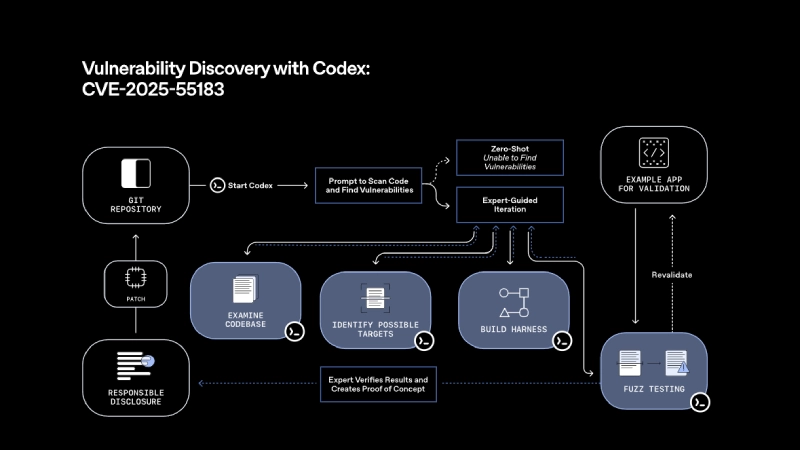
- Facilitating defensive cybersecurity work — allowing the team to discover nooks and crannies of weaknesses and secure design patterns
- Managing multi-file amendments — keeping all the connections of dependencies, functions, and logic across the files
- Adopting development workflows — being compatible with tools, terminals, and IDE extensions.
GPT-5.2-Codex is gradually being made available to paid ChatGPT users across Codex interfaces, with API access anticipated within the next few weeks. OpenAI is simultaneously launching, on an invite-only basis, pilots for selected cybersecurity professionals, thus striking the balance between accessibility and safety concerns.
The Essential Features of GPT-5.2-Codex
1. Long-Context Understanding at an Advanced Level
The ability to mimic human writing when dealing with large volumes of data and project history is one of the significant improvements offered by GPT-5.2-Codex. This lets the model maintain a consistent, internal representation of the codebase across sessions, preventing developers from making mistakes when the model loses track of logic or context.
Fragmentation is one of the significant issues that arise when using traditional models. They would address just one part of the project while forgetting its dependencies or earlier design decisions. GPT-5.2-Codex is equipped with a context compaction mechanism that compresses the required information so it remains visible and usable throughout the long, torturous coding process.
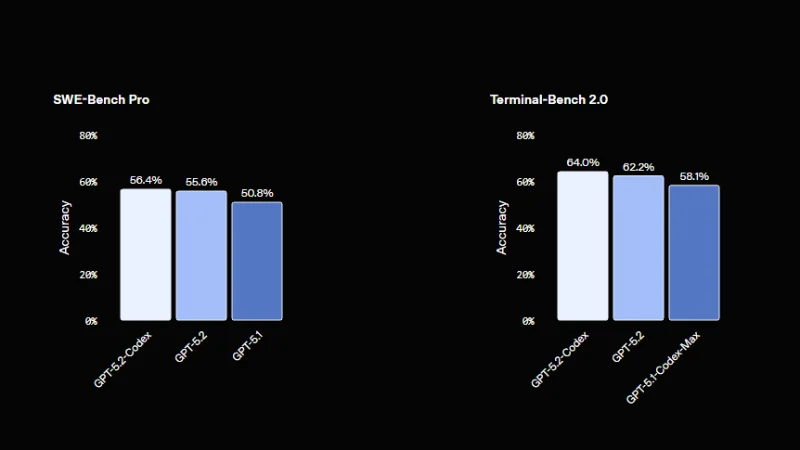
One of the scenarios for which the system is particularly well-suited is code refactoring and migration projects. The developer needs to make changes to the system and document the functional requirements at the same time. This is analogous to a human-like, dictatorial relationship in which a large team can work together with artificial intelligence as a co-worker, reducing the need for manual control and increasing overall productivity.
2. Increased Cybersecurity Awareness
By far, GPT-5.2-Codex has much greater cybersecurity potential than any previous Codex version. OpenAI noted that the model is not yet able to reach the highest cybersecurity capability tier in its internal Preparedness Framework, but the strongest AI support for security work is still through the model.
The main defensive security improvements are:
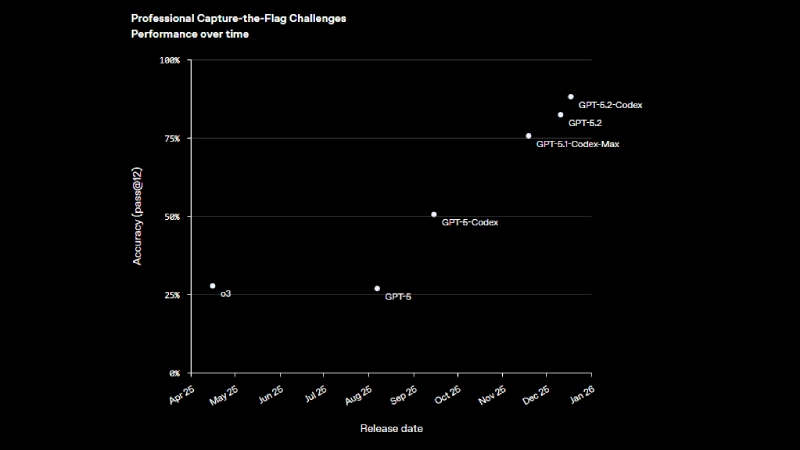
- Professional capture-the-flag evaluation performance — indicating a greater potential in organized cybersecurity challenges.
- Higher knowledge of secure coding patterns — this can help programmers to steer clear of widespread weaknesses like injection flaws.
- Defensive reasoning support — aiding groups in identifying possible attack areas and suggesting countermeasures.
Nonetheless, the OpenAI team does not release models that might be used in offensive or inappropriate ways. The mentioned advancements still represent a timely and meaningful contribution to the researchers’ security area, where AI could be involved in the very first stages of the software development cycle to strengthen codebases.
3. Robust Tool Integration and Reliability
GPT-5.2-Codex has been perfectly integrated with the developer’s tools and environments, so it works more reliably with them. The model has been provided with Windows support, improved grounding of facts, and more reliable tool calling throughout the development workflow.
This means that, through IDE extensions, terminal interfaces, and command-line tools, the model can produce reliable code, which in turn will help reduce errors and speed up development iterations. Rather than generating just independent code snippets, the model can interact with project files, test suites, and build tools, thereby helping the team automate complex steps that previously required extensive manual intervention.
4. Visual Understanding & Prototyping
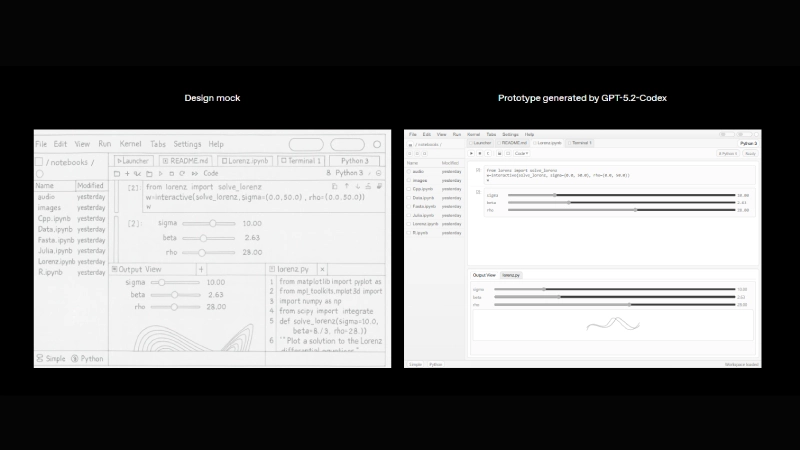
In addition to plain text and code, GPT-5.2-Codex brings visual understanding that can be applied to the development of code prototypes, where the ups and downs of design and implementation overlap. This is all possible in the supported end-to-end development workflows.
When it comes to manually interpreting design assets and coding them according to the specifications, developers can provide the visual elements to the model and receive the corresponding structural or UI code in return. This way, the tension between the design teams and the engineers will be lowered, and thus prototyping and user interface creation will be accelerated.
Enterprise Adoption and Developer Impact
GPT-5.2-Codex is ready to alter organizations’ perceptions of AI in software engineering and cybersecurity, not just as a simple coding assistant but as a collaborator on complicated projects with a strategic perspective.
For enterprise teams, it implies a lot:
- Slashing the time allocated to tiresome tasks
- Fewer mistakes while making more profound codebase transformations
- Playing the role of a security guard early in development cycles
- Creating a secure connection among design, development, and security teams
Since GPT-5.2-Codex improves reliability and context retention across sessions, it may significantly reduce the mental burden on human engineers, allowing them to focus on architecture, user experience, and higher-level problems rather than routine or repetitive tasks.
Balancing Innovation with Safety
The more powerful AI models become, the stronger the concerns about misuse. In contrast to this perspective, OpenAI has made it very clear that the deployment practices of GPT-5.2-Codex will be very cautious, and access will be balanced with safeguards to prevent applications from becoming harmful, especially in the field of cybersecurity, where the risks of dual-use exist.

The delivery of this cautious approach comprises:
- Access restrictions for advanced cybersecurity features only through invited trusted professionals
- Phased accessibility via paid ChatGPT and eventual API rollout
- Robust monitoring and safety controls in accordance with OpenAI’s Preparedness Framework
Such safeguards aim to ensure that GPT-5.2-Codex’s advanced capabilities empower defenders without inadvertently helping bad actors exploit systems.
Conclusion
GPT-5.2-Codex represents a significant step forward in the evolution of AI for coding and cybersecurity, moving beyond simple code generation into a new era of agentic, long-horizon AI capable of tackling real-world software engineering challenges. With improved context reasoning, better integration into development workflows, stronger defensive security tools, and the ability to bridge design and implementation, GPT-5.2-Codex is set to become a cornerstone tool for professional developers and enterprise tech teams around the world.
By building on the earlier capabilities introduced in GPT-5.2 and tailoring them for coding-centric tasks, OpenAI is signaling a future in which AI is not just an assistant but an intelligent collaborator capable of understanding, maintaining, and improving complex systems at scale.