





Table of Contents
Highlights
- Smart wallets combine tracking, biometric locks, and RFID shielding to enhance everyday security.
- Tracking features reduce loss anxiety but are more effective for prevention than theft recovery.
- Biometric locks offer strong security but introduce usability and battery-dependence risks.
- RFID shielding remains the most reliable and low-friction smart wallet feature for travellers.
Indeed, the wallet is one of the most unyielding items in the daily world. Vanishingly small in the past, but even in those days, the wallets would perform the inverse function of the human body; they would hold almost everything the user considered essential: money, identity papers, and small personal items, and that in the most compact and portable way.
Still, the pressures of the digital age, contactless payments, identity theft, constant travel, and the growing anxiety around loss and theft have begun to reshape even this most traditional accessory. The smart wallets – tracking modules, biometric locks, and RFID shielding- are some of the devices that have been introduced in portable physical security for traditional carry devices. This article analyses whether these devices really provide security and convenience or just bring about new dependence and risks, especially for travellers, commuters, and ordinary users.
The logic behind the smart wallet
The smart wallets are the result of a combination of two worries. The first one is about losing things. Nowadays, a wallet can be not only a cash holder but also a carrier of debit cards, credit cards, IDs, and access credentials. Losing one might cause a lot of inconvenience that goes way beyond its monetary value. The second one is about theft occurring invisibly. RFID skimming, data cloning, and unauthorised access to contactless cards have become part of the security measures that people consider, even though the actual number of incidents is much lower.
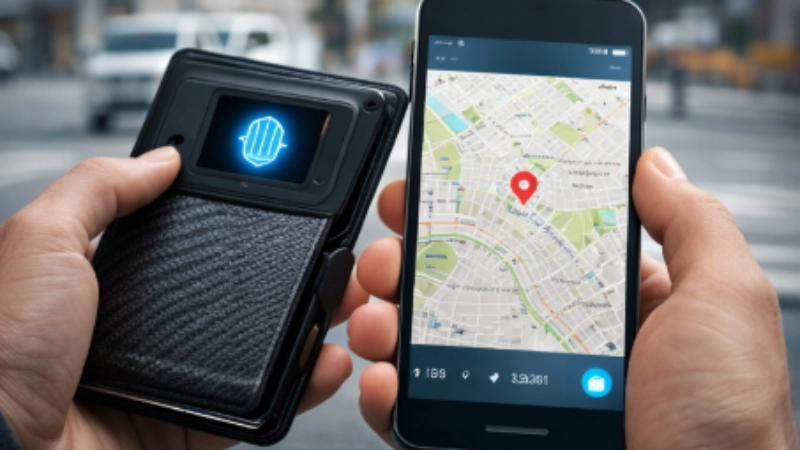
The smart wallets are a way of technological innovation to counter both worries. By incorporating digital protections into a physical object, they are trying to apply the rules of cybersecurity to everyday use. However, this hotel of security is not equally distributed among the products. The wallets are divided into two main camps: the passive protection types focusing on RFID shielding and the active security types that are equipped with GPS tracking, Bluetooth alerts, or biometric locks. To recognise their usefulness, one should analyse the operation of these features in practice rather than in marketing abstractions.
Tracking and location awareness
Location tracking is one of the features that smart wallets usually have, and it is commonly provided via Bluetooth or GPS. Among the products are the ones from Ekster, which include slim tracking cards that work with a smartphone app. The user gets notified when the wallet moves out of range; if it is lost, the app shows the last known location.
The daily commuters can count on psychological reassurance, thanks to this feature rather than absolute security. Bluetooth-based tracking is effective in bounded environments, offices, cafés, and homes, but loses reliability once the wallet is out of range. GPS-enabled wallets offer broader coverage, but they introduce battery constraints and increased bulk, which runs counter to the wallet’s minimalist ethos. Travellers may find tracking particularly useful in transit hubs or hotels, yet even here recovery depends on timely notification and cooperative environments.
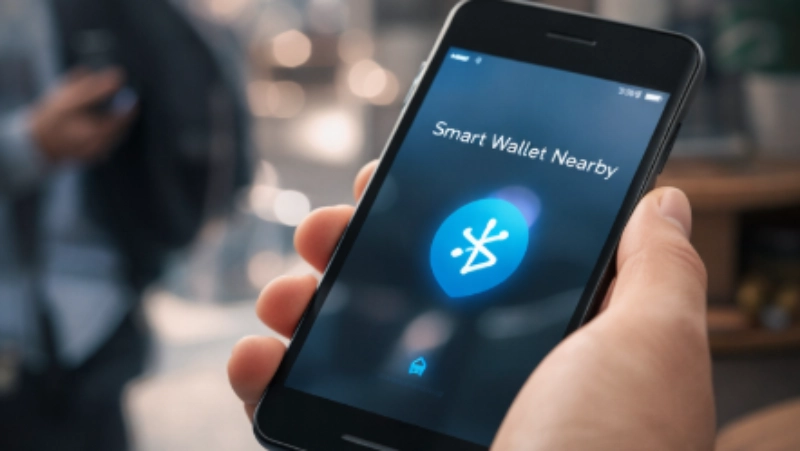
Product evaluation suggests that tracking works best as a loss-prevention tool rather than theft recovery. The moment a wallet is deliberately stolen and powered down or shielded, most consumer-grade tracking systems lose effectiveness. Nonetheless, as an early-warning system for everyday forgetfulness, tracking remains one of the more defensible smart wallet features.
Biometric locks and mechanical security
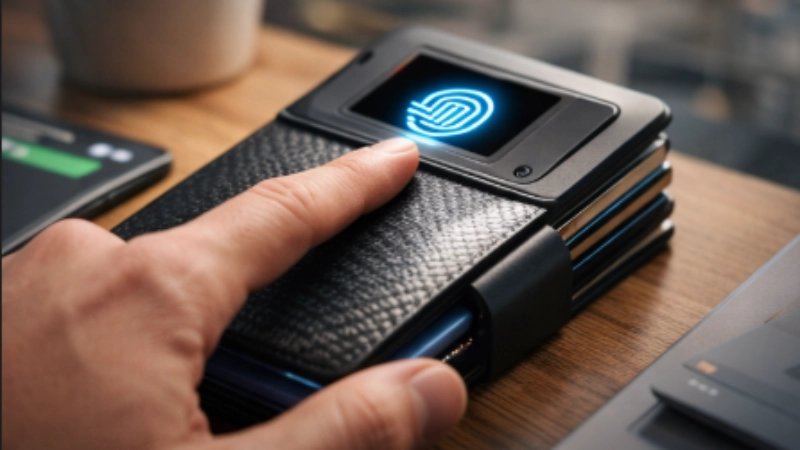
The most daring smart wallets include a feature for locking by biometrics, with the fingerprint sensors being mostly used to avoid access to cards or places. The company Walli and its like have introduced wallets that are secured by fingerprints as the physical equivalent of smartphone security, claiming that sensitive cards are in need of the same protection as digital data.
As a matter of fact, biometric locks are risky on both sides. The advantageous point is that they significantly curtail opportunistic theft. A lost or stolen wallet cannot be opened right away, which gives the owner time to cancel cards or track the device. For tourists who have several cards or might lose a sensitive ID, this delay can be very helpful.
On the other hand, the systems based on biometrics entail a risk of unreliability. Fingerprint sensors can give wrong readings because of sweat, dust, or gradual sensor deterioration. Besides, battery consumption becomes crucial: a wallet that cannot be opened because the battery is dead turns from a secure to an unusable one.
Unlike a mobile phone, which is usually charged daily by the users, wallets are not considered in the same category as electronic devices, hence the higher risk of neglect. From a daily-use viewpoint, biometric locks are justifiable for niche users with very high security concerns but may come across as unnecessary or too delicate for people’s everyday commuting.
RFID shielding
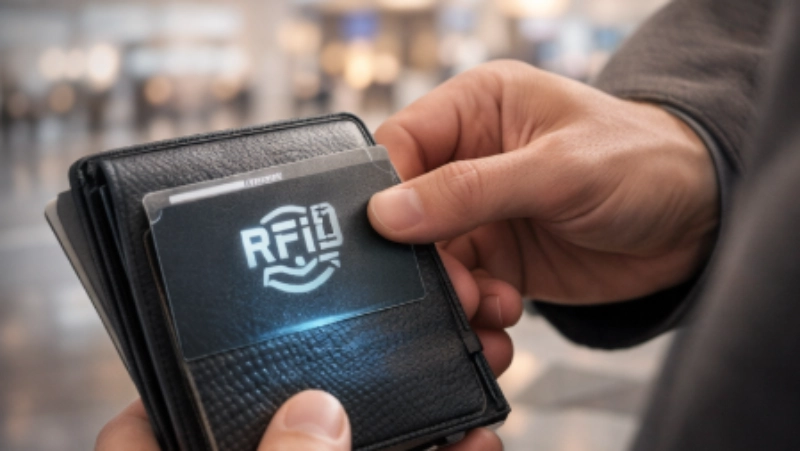
Materials that block RFID are now considered standard even in non-electronic wallets, but they are still one of the main selling points of smart wallets. The reasoning is quite simple: contactless credit cards work by radio frequency communication, and the materials that are used to shield them keep the unauthorised scanning away.
For tourists, especially those who are passing through busy transit systems or tourist spots, RFID shielding is a kind of passive protection that is inexpensive and has no negatives. Unlike tracking or biometrics systems, it does not need a battery, an app, a behavioural change, etc.
That said, critics argue that RFID skimming risks are often overstated, particularly given transaction limits and bank-side fraud protections. Even so, the inclusion of RFID shielding aligns well with the wallet’s traditional role: invisible, always-on protection without active management. In this sense, it represents the most successful fusion of old and new design logics.
Everyday convenience and ergonomic trade-offs
A wallet’s success ultimately depends on daily usability. Smart wallets often struggle here. Added electronics increase thickness and weight, while rigid casings needed to house sensors or batteries can compromise comfort. Designs from companies like Ekster attempt to mitigate this through modular construction, allowing users to remove tracking cards or battery modules if they prefer a slimmer profile.
For commuters, speed matters. Wallets that incorporate quick-access card ejectors or minimalistic layouts often outperform traditional bifolds in daily use, regardless of their “smart” features. When digital enhancements complement these ergonomic improvements, the product feels coherent. When they detract, for example, by requiring frequent charging or app maintenance, the smart wallet risks becoming a burden rather than a convenience.
Travel use cases
Travel is the context in which smart wallets make the strongest case for themselves. The combination of unfamiliar environments, high-density public spaces, and dependence on multiple cards amplifies both loss anxiety and security risks. Tracking alerts can warn travellers when a wallet is left behind in transit, while biometric locks can delay misuse if theft occurs. RFID shielding adds a layer of passive defence in crowded areas.

However, travel also exposes limitations. International roaming may affect app functionality, batteries may drain faster, and replacement or repair options are limited abroad. A smart wallet that fails while travelling can create more stress than a traditional wallet ever would. Consequently, product reliability and fallback usability, the ability to function as a normal wallet if electronics fail, are critical evaluation criteria.
Data, privacy, and the irony of surveillance
Smart wallets raise a subtle but important privacy question. In attempting to secure physical identity and financial tools, they introduce new data streams: location histories, usage patterns, and app-linked identities. While most manufacturers claim minimal data collection, the very act of pairing a wallet to a smartphone creates a digital shadow of one’s physical habits.
For privacy-conscious users, this irony is not trivial. A wallet historically represented offline autonomy; smart wallets partially reverse that logic. The trade-off between physical security and digital exposure must therefore be evaluated individually. Travellers concerned about theft may accept location tracking, while everyday users might prefer simpler, non-connected designs.
Targeted utility rather than universal replacement
Smart wallets are not a wholesale replacement for traditional wallets, nor are they mere gimmicks. Their value is highly context-dependent. RFID shielding and ergonomic card access offer near-universal benefits with minimal cost. Tracking features meaningfully reduce everyday loss anxiety, particularly for commuters and travellers. Biometric locks provide strong security in theory, but demand behavioural discipline and tolerance for technological failure.
From a broader perspective, smart wallets illustrate a transitional moment in everyday technology. As physical objects absorb digital logic, they challenge assumptions about what should be connected, monitored, and secured. The most successful smart wallets are those that respect the wallet’s original purpose, simplicity, reliability, and discretion, while selectively augmenting it with technology that fades into the background rather than demanding constant attention.
For travellers and high-mobility users, a well-designed smart wallet can be a genuine upgrade. For daily users, the question is less about maximum security and more about balance. Convenience, reliability, and trust remain the true currencies of the pocket — digital or otherwise.
