

Tesla has achieved a significant achievement in its development path for self-driving vehicles because the company announced that its initial production, the Tesla Cybercab has been completed at its Gigafactory Texas facility. Tesla used its official social media channels to announce the news which was also confirmed by CEO Elon Musk, who said that the company had begun development work on its long-awaited robotaxi system.
The Cybercab serves as Tesla’s first dedicated self-driving vehicle which the company developed for its planned future self-driving ride-hailing service, and its first finished unit indicates that the company has begun its next phase of robotaxi development.
First Tesla Cybercab Built at Giga Texas
Tesla confirmed that the first Tesla Cybercab has been produced at its Austin-area Gigafactory, with photos showing employees gathered around the vehicle at the end of the production line. The vehicle functions as an electric robotaxi system which requires full autonomous operation because it lacks all standard driving controls including steering wheels and pedals.
The milestone suggests Tesla has begun early production builds ahead of a broader manufacturing ramp-up. The company plans to start developing its dedicated robotaxi fleet through this initial phase which will create a limited number of vehicles that operate as special robotaxis instead of using existing Tesla models.
Gigafactory Texas, which already produces vehicles like the Model Y and Cybertruck, is serving as the primary hub for Cybercab manufacturing and development.
A Purpose-Built Robotaxi Platform
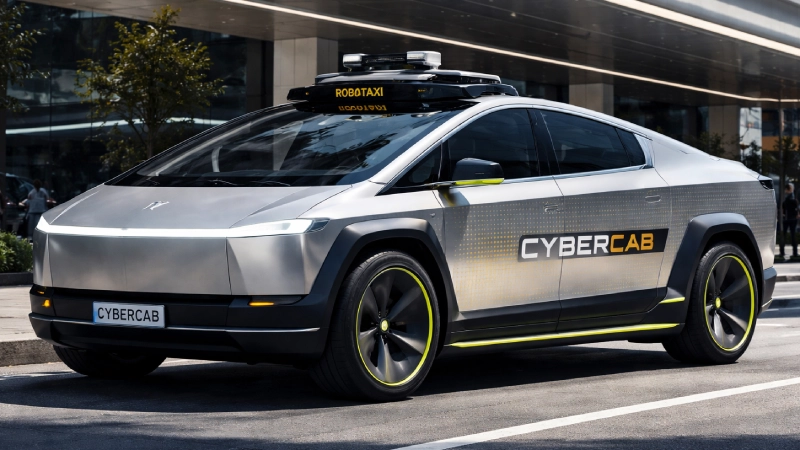
The Cybercab system operates its functions through autonomous driving technology which completely replaces manual driving controls used in Tesla vehicles. The two-door electric vehicle is meant to operate without a human driver and is expected to form the backbone of Tesla’s planned robotaxi service.
Tesla has already begun its first tests for autonomous ride-hailing services in Austin by using its current vehicle fleet. The Cybercab system serves as the main replacement for temporary solutions through its affordable design which has been specifically designed to optimize shared rides and fleet operations.
Reports suggest that Tesla plans to maintain production costs within affordable limits which will allow the company to achieve widespread product availability. The company aims to set a final consumer price between $25,000 and $30,000 based on product configuration and government permission.
Production Begins, but Ramp-Up Will Take Time
The first unit has been finished yet the organization remains in initial manufacturing stages. Tesla plans to increase production output because it needs to improve production operations and confirm the vehicle design. The company uses early builds for testing purposes to develop assembly systems which will be used in future production operations.
Some reports indicate that broader production could begin later in 2026, though timelines remain flexible. The company plans to use early vehicle units for internal testing purposes before the products become available to the public.
Tesla uses a phased approach which three active Tesla models to manage production testing operations because initial manufacturing runs enable the company to determine proper production methods before it starts major production increases.
Regulatory and Technology Challenges Remain
Cybercabs need to overcome multiple challenges which prevent their use on public roads despite achieving their production goal. Vehicles that lack steering wheel and pedal controls must comply with safety standards in the United States and other countries which currently function under regulations that assume drivers maintain manual control of their vehicles.
Tesla continues to develop its autonomous driving software. The company offers limited robotaxi services with its current fleet but plans to expand its operations into driverless territories through more testing and regulatory processes.
Before Tesla can introduce its fully autonomous vehicles to the public, the company must prove that its self-driving technology will operate safely on roads throughout the day. The speed at which Cybercabs become available to the public depends on how fast companies can solve their present difficulties.
Why This Milestone Matters
The first Cybercab rolling off the production line represents more than just a new vehicle launch — it highlights Tesla’s long-term strategy. The company has repeatedly emphasized that autonomous ride-hailing could become a major revenue source in the future, potentially transforming how Tesla generates income beyond vehicle sales.
Tesla now demonstrates its robotaxi vision through the development of actual production units which follow earlier concept demonstrations. The Cybercab forms the basis of their business model which will start in one city but later expand to multiple locations.
Gigafactory Texas also plays a crucial role in this strategy, serving as a manufacturing hub for Tesla’s next-generation vehicles and technologies.
What Comes Next
Tesla plans to construct more Cybercab units during the upcoming months while the company works to enhance its manufacturing and testing capabilities. The company will start its first controlled environment tests after succeeding with its scheduled production ramp-up.
The date when people will start using the product as their main method of transportation remains unknown. The arrival of Cybercabs to city streets will depend on three factors which include receiving regulatory approval, achieving software readiness, and conducting safety validation.
The first Cybercab which Tesla produced at its manufacturing facility represents both a practical achievement and a symbolic milestone that will lead to Tesla’s autonomous future. The development will transform Tesla’s business operations together with the entire transportation sector if the company achieves its strategic goals.