
Highlights
- AI tools are revolutionizing the way routine work is structured, done, and assessed
- Automation has already taken over not only routine tasks but also creative and supportive decision-making
- Intelligent booking, writing help by AI, and management of workflows through technology are becoming standard in the workplace
- Job positions are changing with the introduction of new skill sets rather than going extinct
- While the productivity increases are being welcomed, there are also fears about watching over employees, reducing their skills, and heavy reliance on AI
- The workplace of the future will give preference to those who can adapt rather than those who are perfectly skilled.
Introduction: Work Is Changing Quietly, Not Dramatically
The coming of the future of work is not marked by a single, disruptive event. On the contrary, there are not any mass layoffs due to AI overnight nor has human labor suddenly become redundant. It is rather a slow and quiet process that is happening and is already integrated into the everyday tools that are used by workers.

Calendars are automatically scheduling their appointments. The emails are being composed. Documents are generating the first drafts without human intervention. The tasks are being prioritized automatically, the meetings are being summarized and the workflows are being optimized in the background.
In the year 2026, the work is still recognizable but the way of operating is very different.
The use of AI-powered tools for productivity is not replacing labor in a dramatic and movie-like manner. It is transforming the way work is done at the most basic level and resulting in a change of the time spent on various activities, the way decisions are made, and the most important skills.
From Task Management to Workflow Automation
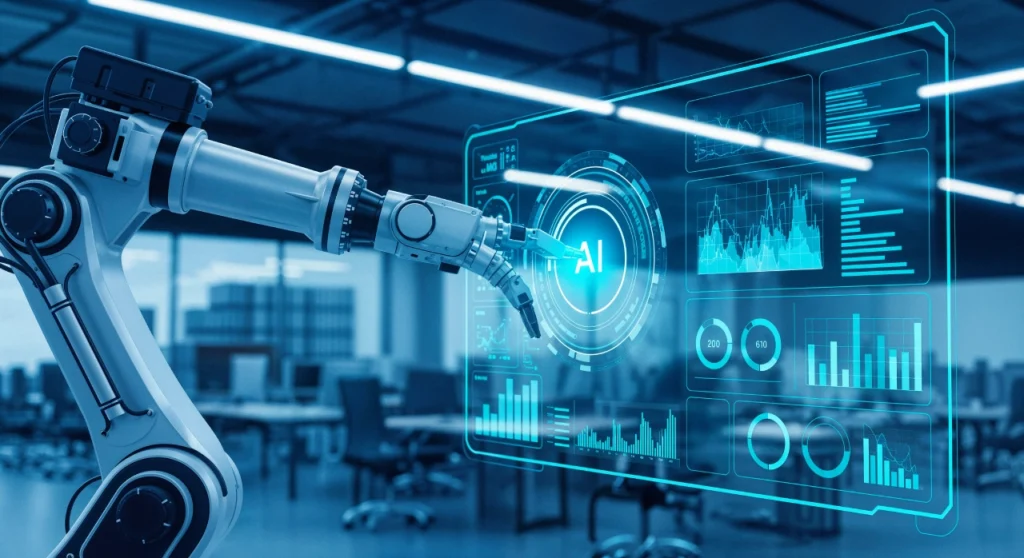
The early productivity software was all about organization. To-do lists, calendars, and project boards were the means through which workers managed their obligations. AI tools go even further by not just documenting the flow of work but actively controlling it.
The current systems are looking at the deadlines, the way the work is allocated and the user’s habits in order to set the tasks dynamically according to their importance. Rather than asking the users what needs to be done next, the AI tools are more and more deciding for them — proposing the most efficient order, marking the delays, and even shifting the time automatically.
This transition lessens the mental burden. The workers have to put less effort into deciding *what* to do and they are spending more time in fact doing it. For a large number of specialists, this represents fundamentally a different way of organizing the workday.
Auto-Scheduling and the End of Calendar Chaos
Scheduling meetings has been for a long time an invisible way of losing productivity. Finding a suitable time for people in different teams, in different time zones and with different priorities can sometimes even take longer than the meeting itself.
Now AI-powered scheduling tools are automatically taking this over. By checking calendars, preferences and urgency of the meeting they suggest meeting times, reschedule conflicts and even decline low-priority requests on behalf of the user.
This automation is indicative of a larger phenomenon: AI is progressively ruling as a gatekeeper for people’s attention. Time, once managed passively, is now being actively guarded and made more efficient with algorithms.
Although this is a gain in efficiency, it also imperceptibly takes away the individual’s control, thus giving rise to concerns regarding autonomy in AI-dominated work spaces.
Smart Document Drafting: From Blank Page to First Draft
One of the most noticeable changes on the everyday work scene is the way documents are being produced. AI-powered writing assistants are already integrated in word processors, email clients, and collaboration platforms.
These technologies make outlines, and summaries, reports, and presentations in just a few seconds. For most employees, the toughest part of writing: starting has been more or less taken away.
What is more, AI is not so much taking human authorship as speeding it up. Workers do not compose everything from scratch but rather edit, refine, and contextualize AI-generated drafts.
This has an impact on the skill profile of knowledge work. Editing, critical thinking, and domain expertise become more important than just raw output speed.
Automation Moves Up the Value Chain
Previously, the focus of automation was on low-skill and repetitive tasks. Today’s AI applications, however, are starting to operate in the upper part of the value chain.
Sales staff employ AI for the purpose of customer interaction analysis and next-step action suggestions, whereas managers get performance insights generated by AI. Along with AI-assisted coding and debugging, the developers are also dependent on them. On the other hand, marketers’ main activity is large-scale automated content variation and testing.
Despite this, human presence is not entirely eliminated it just gets redefined. Human personnel would not be the ones doing everything but rather supervising, curating, and making the decisions.
Moreover, the demarcation line between “technical” and “non-technical” positions is not very clear anymore. The introduction of AI tools has opened up the complex work area, and now more people from different teams can take part in it.
What This Means for Jobs: Evolution, Not Erasure
There is still the apprehension that AI will completely take over human roles in the workforce, but the truth is more complicated. The situation in most sectors is that functions are changing faster than they are becoming obsolete.
Secretary jobs are focusing more on coordination instead of just data entry. Authors are transforming into editors and strategists. Data analysts are devoting less time to gathering data and more to data interpretation.
Besides these changing roles, new ones are emerging, such as AI workflow designer, automation auditor, human-AI interaction manager, and prompt specialist. These positions were not around a few years back, but are now becoming indispensable in AI-enabled offices.
The difficulty is not in mass unemployment but rather in the different rates of readiness to adjust to the situation. Workers who reskill themselves and embrace change are the ones who benefit the most, while those who stand still risk being left behind.
Productivity Gains and the Pressure to Do More
The deployment of AI for the purpose of efficiency has created a situation that seems to be a contradiction. On one hand, tasks are done quicker than before, while on the other hand, the employees have to meet even higher expectations. The rapid output does not necessarily mean the workdays have become shorter; on the contrary, it leads to the employees being assigned more work.
The situation that has arisen is similar to that of previous productivity gains. It is the whole organisation that reaps the benefits in terms of shorter working hours rather than the individual employees who are doing the work.

AI tools may be time savers but the time saved is soon consumed if there is no change in the existing culture.
For that matter, if technology is going to be an important factor in the future of work, then it will be the choice of the organisations to implement it that will determine its impact on the workplace.
Surveillance, Trust, and the Invisible Manager
One of the main functions of AI productivity tools is that they usually gather very comprehensive data regarding the employees’ work habits. Various parameters such as keystrokes, response times, task completion rates, and collaboration metrics are all subject to monitoring and analysis.
This data is a double-edged sword as it can lead to increased efficiency on one side but at the same time, it can create a surveillance-like situation on the other. Workers might feel that they are under constant scrutiny from systems that they don’t completely understand.
The trust issue becomes very prominent here. It is important to have transparency when AI systems affect promotions, workload distribution or performance appraisal.
The future office will demand clear lines drawn between the areas of optimization and intrusion.
Creativity in an Automated Workplace
The argument is brought up quite often that automation might be the cause of limiting creativity. There are a variety of activities like idea generation, writing, or problem-solving done by AI, then what part is left for humans?

In a real-life situation, AI usually goes hand in hand with human creativity, thus the capacity to create is not replaced but rather augmented. The drudgery involved in the creative process is taken care of by the AI so that the human can then do the more important things like thinking, experimenting, and judging.
Nonetheless, this advantage is not automatic, and it is very much dependent on the deliberate decision made for its use. Becoming too dependent on AI for content generation can lead to a uniformity that is efficient but dull and lacking inspiration.
In the age of AI, Creativity would require the active involvement, that is directing humans, not passive tolerance.
Skills That Will Matter More Than Ever
The automation of execution by AI results in humans shifting to the skills area where machines fail to copy.
Critical thinking, ethical judgment, emotional intelligence, and contextual understanding are the skills that are predominant. The ability to confront AI outputs, detect bias, and make subtle decisions become more and more vital.
Teaching professionals to partner with AI rather than fighting it will become a necessary skill.
Workplaces in the future will reward those who not only control the tools but also understand the systems behind them.

The Human Role in an Automated Workflow
Work has been and will continue to be a human enterprise, even with the increasing automation. AI can recommend, produce, and refine but it does not set the direction, values, and significance.
Humans determine the priorities, the limits of what is acceptable, and the what is considered good results. AI operates within those parameters.
The labor of the future will not be characterized by humans going against machines, but rather by humans receiving extra power from machines.
Conclusion: A New Normal, Already Here
The future of work is not a concept that is yet to be realized; it is already a part of our everyday lives, gradually changing the way we utilize time, energy, and skills.
Workflows are being automated, and the productivity is being accelerated, while the roles are being redefined, humans are not being eliminated, but rather their work is being transformed.
The workers’ challenge is to be flexible. The organizations’ challenge is to be responsible. The society’s challenge is to make sure that the gains in productivity are converted into better work not just more of it.
The tools are available. The next decade of work will be shaped by what we create out of them.