


Highlights
- BCIs are transitioning from lab experiments into real clinical trials with human participants.
- Neural implants show promise for restoring movement, speech, and motor function.
- Ethical, safety, and privacy concerns remain major barriers to mainstream use.
- The next leap in BCIs will be medical restoration rather than direct cognitive enhancement.
Direct connection of the human brain with machines is the subject of the world’s most controversial and fascinating technologies. Neural implants and brain-computer interfaces (BCIs), being the most notable technologies in neuroscience, medicine, and computing, challenge the long-standing view of a clear demarcation line between biology and technology.
In 2026, this area is at a critical point. The once speculative and distant science fiction has become experimental medicine. Humanity trials are already in progress. Patients with paralyzed limbs are using thought-driven interfaces to communicate. The process of brain signal decoding and translation into action is already.
However, the technological advancements are still nowhere near the end despite the large number of daring claims and media coverage. The question now is not about the feasibility of brain-machine interfaces but rather if they are ready for the next leap, beyond strictly regulated medical settings.
What Are Brain–Computer Interfaces?
A BCI is a device that allows interaction between the brain and a machine or computer. It does not go through the normal channels of muscle movement and speech, but rather the activity of neurons in the brain is detected by BCIs and converted into commands.
BCIs generally fall into two categories.
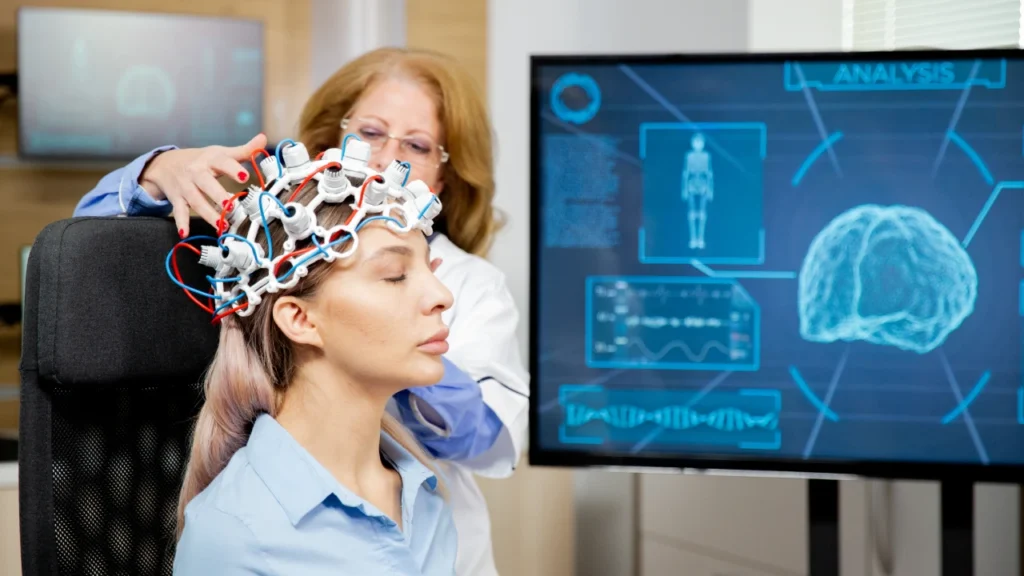
Non-invasive methods detect brain activity with the help of external devices like EEG, which means they measure brain waves through the scalp. Though less hazardous, these kinds of systems have lower resolution and reliability.
On the other hand, neural implants are the more invasive kind of BCI, where electrodes are implanted surgically into or on the brain. This approach provides much better signal quality and accuracy, but also carries the risk of surgery and concerns about safety over a long period of time.
Invasive systems have been the ones responsible for the most significant progress in recent years.
Medical Use Cases: Where BCIs Are Already Changing Lives
The most robust and widely accepted applications of BCIs in humans are the medical ones. The cases of patients with spinal cord injury, ALS, stroke-caused paralysis, and severe neurological disorders have been the ones where BCIs have provided, for the first time, the unimaginable: a return to control over one’s own actions.
Such patients have harnessed the power of implanted electrodes to move robotic arms, direct cursors, write text, and even articulate words through the brain’s natural signals. In some instances, BCIs circumvent the compromised neuronal pathways, making it possible for the brain to directly connect with the external systems.
These breakthroughs are not just laboratory oddities but rather practical solutions that play a role in improving people’s living standards. For the people who lost the ability to communicate or move their bodies, the power to express themselves via mind-reading is a great lever in their hands. Medical advancements like this one are taking place and multiplying; the progress is visible and measurable.
Elon Musk’s Neuralink: Acceleration Through Attention
When talking about neural implants, it is a must to mention Neuralink. The revolutionary company of Elon Musk has drawn public attention to BCIs’ unprecedented, assuring that extremely high-bandwidth Brain-Computer Interfaces could finally lead to cognitive enhancement, memory storage, and human-AI symbiosis being possible, albeit far in the future.
Neuralink’s technique relies on the use of extremely thin electrode threads that are implanted by robotic systems with the objective of cutting down on the damage to the tissue and increasing the stability of the signal. The first human implants of the company have allowed the demonstration of very basic functionalities like controlling a cursor and entering text through thought.
Still, Neuralink has opened up the industry with its increased funding, talent, and public interest, but it has not really solved the hardest problems of the field. Long-term biocompatibility, signal degradation, and safe removal or upgrade of implants are still problems that need to be tackled. The hype often exceeds the science in the case of BCIs.
The Hard Problem: The Brain Is Not a Computer
One of the factors that slows down the development of BCIs is that the brain does not work like digital hardware. The brain’s activity is characterized by noisy, adaptive, and context-dependent signals. The same intention can lead to different neural patterns if the person is tired, excited, or has just learned something.
This makes the task of decoding thoughts much more complicated than simply reading electrical signals coming from a microchip. Machine learning has made great strides in pattern recognition, but model training still takes a lot of time, adjustments, and tailoring to individuals.
BCIs can yield the best results when the brain itself learns how to operate them, a process that is more like the development of a new sense than installing new software. It is not possible to circumvent this learning curve of biological origin through engineering.

Safety, Longevity, and Body’s Response
Immune responses are triggered by the presence of foreign objects in the brain. Gradually, scar tissue may surround the electrodes, leading to poorer signal quality. The devices have to be replaced occasionally, which raises the issue of the medical operation being performed again and again.
Power supply is yet another hurdle. Implants are required to function with very little heat as well as very high reliability. Wireless charging and data transfer lower the risk of infection but make the process more complicated.
These problems can be solved in the case of short-term trials, but are a major hindrance to the large-scale use of such technology. Neural implants are not something you can do with a smartphone; it is a lifelong decision to undergo medical surgery.
Ethics: Who is the Owner of Neural Data?
Neural data is probably the most personal data that one could think of. This type of data shows the innermost feelings of a person, for example, intentions, emotions, and even thoughts. So as BCIs get better and better, problems about data ownership, consent, and misuse will be unavoidable.

In the case of an implant, whose neural signals are they, the patient’s, the manufacturer’s, or the healthcare provider’s? Are they going to be able to be subpoenaed, hacked, or sold?
Neural implants are much less of a hassle than smartphones or wearables; they can’t easily be taken off or turned off. So, ethical frameworks must be stricter than data regulations and still looser than existing ones. More than the technical capability, this ethical aspect will be a decisive factor in public acceptance.
Enhancement vs Therapy: A Distinction with a Difference
The public’s imagination very often goes from the medical BCIs to the superhumans with enhancements such as quick learning, memory increase, and communication directly between brains. However, actually, enhancement is still a distant dream.
Medical uses make the risk worthwhile since the only alternative is to lose one’s ability. Enhancement leads to a slight advantage at a probably high biological cost.
A majority of neuroscientists think that, in the near future,e BCIs will only be therapeutic tools. On the other hand, cognitive enhancement is a topic that raises several ethical issues about inequality, coercion, and identity that society has not yet decided upon. The next leap will be for restoring function and not for creating superhumans.
Regulation and Public Trust
The authorities are being very cautious. The approval process for neural implants is similar to that of high-risk medical devices and requires extensive testing and post-implant monitoring. Such caution is warranted. Puppylike software bugs and failures in neural implants can cause permanent harm.
Dependence on public trust will occur through the provision of clear demarcations between the medical necessity and the commercial ambition, long-term safety data, and transparency.
The Role of AI in the Next Leap
Artificial intelligence is the main driver of BCI technology. The approaches based on machine learning are applied to decoding neural activity, personalizing user interfaces, and correcting for signal drift over periods of time.
There is a mutual relationship: AI gets better, and BCIs get more user-friendly and trustworthy. The flip side is the dependence that comes along with it: brain-machine interfaces are more and more relying on non-transparent algorithms for the interpretation of neuronal activity. In-depth knowledge and auditing of these systems will be necessary to avert the emergence of unexpected consequences.
Are We Ready for the Next Leap?
BCIs are making steady and gradual technical progress. Medically speaking, they are already providing some benefits. But in terms of ethics and social acceptance, society is still lagging.
The next leap will not be sudden nor universal. It will occur in hospitals, rehabilitation centers, and controlled trials, certainly not in consumer electronics stores. In this context, readiness means nothing other than responsibility rather than speed.
Conclusion: Progress Without Illusion
Neural implants and brain–computer interfaces are among the most profound technologies ever developed by mankind. They affect identity, autonomy, and the core of human experience.
In 2026, they are prepared to leap forward; however, only inside very strictly defined limits. Medical breakthroughs will be at the top of their list. Patients’ quality of life will be on the rise. Hype about enhancement will be around to stay.
The real challenge is not a matter of technology. It is a matter of making sure that as machines become able to ‘interpret’ the brain, mankind will be the one to determine intentionally how close that connection should be.